Pink lakes and pink slugs: Australia’s most bizarre sights

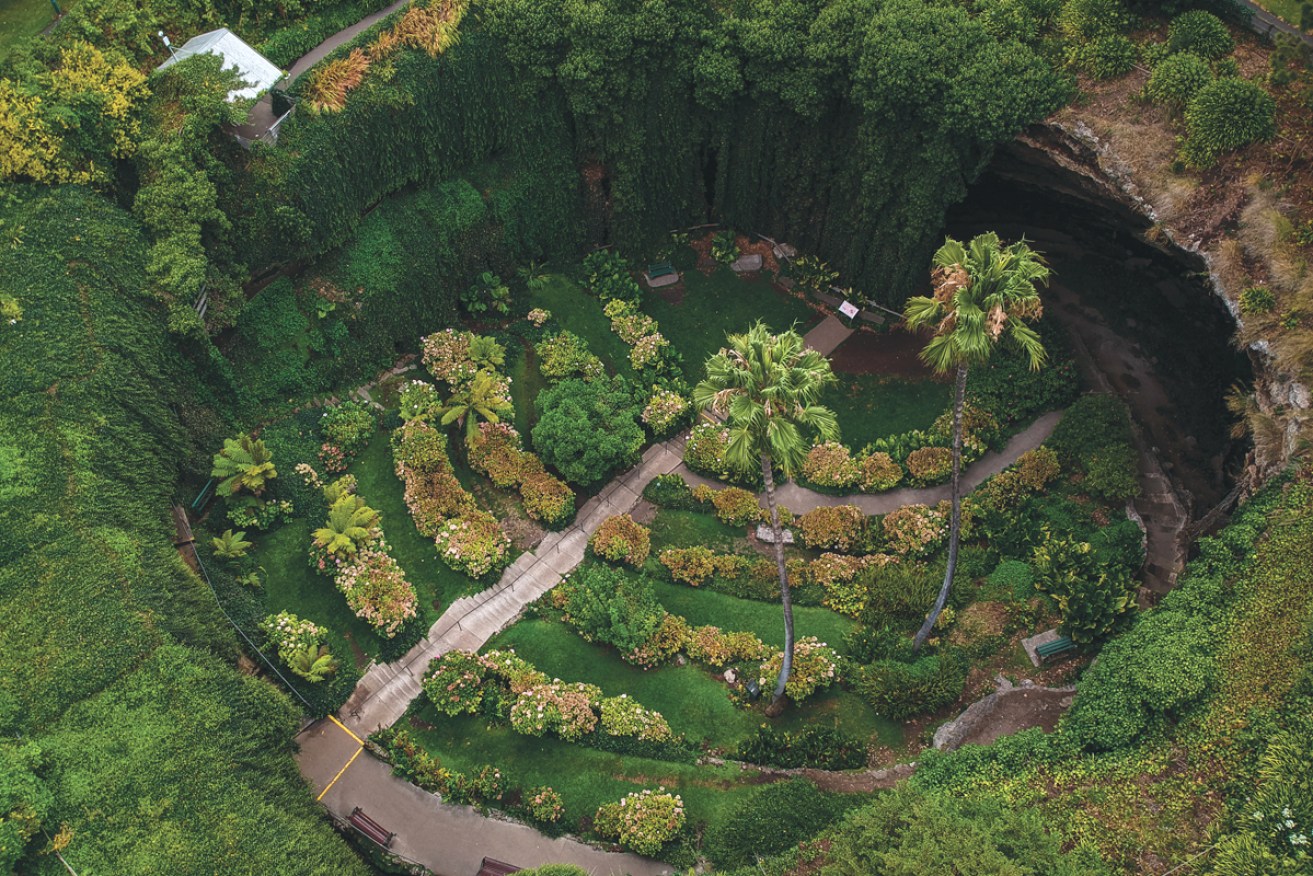
A birds eye view from of the Umpherston Sinkhole in Mount Gambier, South Australia. Photo: Lonely Planet
Australia is home to some of the world’s favourite sights – Sydney Harbour, Uluru and the Great Barrier reef to name just a handful.
But it also has some extraordinary destinations, places that might make you scratch your head on the trip of a lifetime.
Travel publisher Lonely Planet has compiled a list of some of the best for its new Secret Wonders of the World guide book. Here are its top picks:
Lake Hillier, Middle Island, WA
If you were to draw Middle Island, part of Australia’s little-known Recherche Archipelago, you’d need a pink crayon (preferably of a bubblegum hue) to depict its most striking landmark: Lake Hillier.
Hillier’s hue is caused neither by reflection from the lakebed or the dye of seasonal bacteria: It’s beta-carotene, produced by extremophile organisms that extract nutrients from the hypersaline water.
Unprecedented rainfall in 2022 decreased the lake’s salinity, enabling green photosynthesising organisms to dominate over the extremophiles – and dealing a blow to Hillier’s flamingo-toned brilliance, which faded from sherbet to dusky rose. Receding water levels are the only remedy to restore its rosiness, but scientists hopes that Hillier will return to its former glory soon.
Middle Island is part of a wilderness area that’s off-limits to tourists. You can view Lake Hillier on a two-hour helicopter tour from Esperance.
Gnomesville, Ferguson Valley, WA
It may be little more than a humble roundabout, but for some 6000 painted pixies, Gnomesville is the capital of the great Gnoman Empire – its citizens posed in planes, in trains and partaking in every imaginable pastoral pastime.
A local is said to have placed a solitary garden gnome in the hollow of a tree here in the 1990s. Fearing it was lonely, other townspeople followed suit.
The population has grown exponentially since, as visitors from around the world flock to Western Australia to drop off beloved gnomes.
Locals say Gnomesville’s success as a tourist attraction has been so phe-gnome-nal that the population is slowly creeping onto private land. Gnomes placed outside the city limits are allegedly retrieved and brought to Gnomesville proper, where they are placed in a des-
ignated “gnome jail”.
Gnomesville is in Ferguson Valley, 35 kilometres inland
from Bunbury by car.
Grassless golf course, Coober Pedy, SA
Mining towns tend to be pretty soulless places inhabited by gruff grunts and slick-suited businesspeople with dollar signs for eyeballs. I don’t visit these places.
But then I heard about a mining town in the rear end of the Australian outback that was anything but typical.
Flying into Coober Pedy, though, I couldn’t spot a town anywhere in sight. In fact, it looked like a team of extremely large, hungry earthworms had invaded the land below, leaving behind towering pits of rubble and little else. Turns out those holes are mines, and what you find in them are opals. Lots of opals. In fact, an estimated 80 per cent of the world’s supply comes from Coober Pedy.
Vibrant, too, is the life residents have carved out of this burnt-red earth. Most live in dugouts, which maintain a pleasant year-round temperature of about 24 degrees.
Coober Pedy also has glorious subterranean churches and cavernous underground hotels. Yet its most curious attraction may be one above ground.
There’s only one golf club in the world with reciprocal rights at the “home of golf”, St Andrews – and it’s right here in Coober Pedy.
The daytime heat is so oppressive that I opt to play at night with a glow-in-the-dark ball. The only grass this ball will touch is the carpet of artificial turf I’m holding for teeing. The rest of the 18-hole course is utterly lunar-like in appearance. It’s also so difficult that the last of my three glowing balls goes missing down one of Coober Pedy’s signature wormholes, destined to become yet another shimmering orb lost to its kaleidoscopic underworld.
Five flights a week link Coober Pedy with Adelaide. Pay your green fees at Opalios on Hutchison Street.
SS Ayrfield, NSW
Plenty of cities sink decommissioned cargo ships to create artificial reefs, but what happens when you let a 1140-tonne hunk of steel languish on the water for over 50 years? In the case of the SS Ayrfield, you get a majestic “floating forest” where mangroves fight for space atop a rusted hull.
Built in 1911, the Ayrfield helped the Australian government deliver supplies to US troops in the Pacific during WWII (when it was known as SS Corrimal), then ran supplies between Sydney and Newcastle until 1972, when it was sent to a breaking yard in Homebush Bay.
It remains there alongside three other decommissioned ships, but none feature such spectacular foliage. The oft-photographed Ayrfield’s resident mangroves have flourished, billowing over both sides of the hull and slowly ripping the ship apart; it may have survived a war and evaded dismemberment, but it’s only a matter of time before it succumbs to nature.
Take the train from Sydney’s Central Station to Rhodes. Cross Bennelong Bridge for the best views.
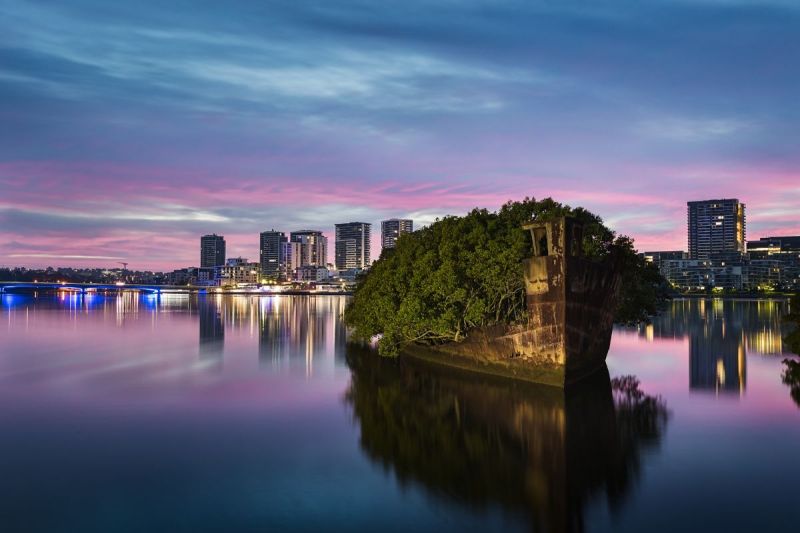
A shipwreck with a view – the SS Ayrefield in Sydney’s Homebush Bay. Photo: Canva
Red-crab migration, Christmas Island
If you’re on Christmas Island at the start of the rainy season, be sure to drive very, very carefully. It’s the time of the annual red-crab migration, and these little fellas have just one thing in mind. Cars, trucks, bicycles – all become insignificant, compared to the overwhelming urge to procreate.
Triggered by the first droplets of rain, crabs crawl from underground burrows deep in the forest and start their slow sideways creep to the beaches, some eight kilometres away. Within hours, the trickle becomes a rolling red tide of tens of millions of grumpy-faced crabs, driven on by their deep-rooted impulse to mate, and hellbent on making it to the sea.
It’s an instinctive but tight schedule: Migration, burrow digging, wooing and mating must all be timed to coincide with a receding high-tide during the moon’s last quarter. Only then will females shimmy into the surf to spawn precious eggs.
So, it’s no wonder that nothing stands in their way. Despite road closures, crab fences and purpose-built underpasses, hordes of crabs play chicken with local traffic – rangers armed with plastic rakes patrol the streets, scooping them out of harm’s way. Drivers should be thankful for this: The crabs’ shells are tough enough to cause punctures.
Christmas Island can be reached by air from Perth (Australia)
and Jakarta (Indonesia).
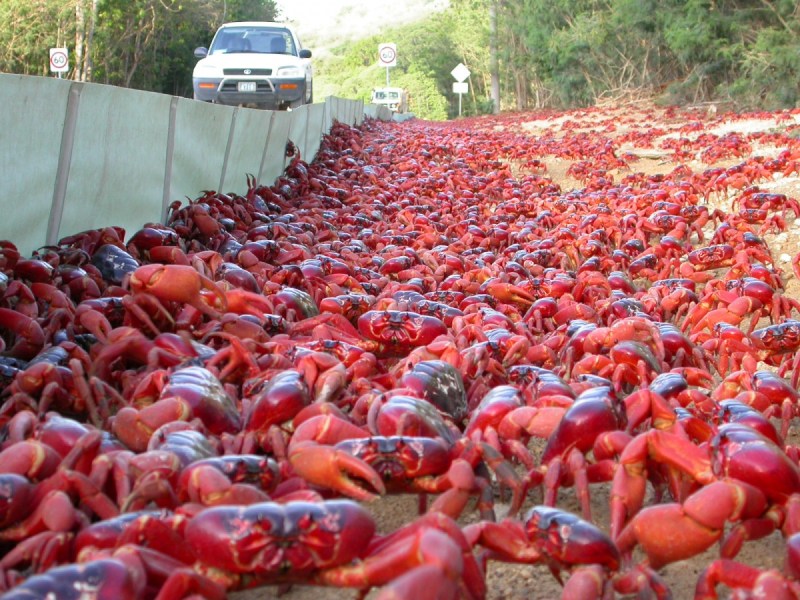
Christmas Island’s red crabs on the move. Photo: Christmas Island Tourist Association
Giant pink slugs of Mount Kaputar, NSW
Arrive at Mount Kaputar National Park on a stormy night and you’re in for a slimy surprise: A creature as wet as your tongue, as long as a cucumber and as fluorescent-pink as a nylon tutu.
Picture, if you dare, a giant hot-pink slug. These startling slitherers
(Triboniophorus aff. graeffei) are found only on remote Mount Kaputar in Australia’s Nandewar Range, and spend most of their time feeding underground – but after rain, they rise to the surface to dine on lichen and tree moss.
Remarkably, they’re but one of many endemic invertebrates who’ve lived here in relative isolation for millions of years – from geometrically decorated red triangle slugs to cannibal land snails. Scientists say this unique habitat offers a unique glimpse into Australia’s geological past.
Mount Kaputar National Park is a 30-kilometre drive east of
Narrabri, with campgrounds and bushwalking areas.
Umpherston Sinkhole (Balumbul), Mount Gambier, SA
For an erstwhile sheep station, the South Australian city of Mount Gambier is rich in natural wonders: There’s the namesake volcano, the oat-milk-coloured cliffs of the Limestone Coast, and the Blue Lake (Warwar), which glows electric blue between November and March – thanks to the alchemy of warm temperatures and microscopic salt crystals.
But the Umpherston Sinkhole, on the east side of the city, stands out as an unexpected fusion of natural beauty and artistic vision.
The sinkhole appeared when a cave roof collapsed and exposed a 50-metre-wide pit. Sudden sinkholes aren’t unheard of around Mount Gambier, where the action of rain on limestone bedrock has gradually eked out a honeycomb of subterranean caves.
Scottish settler James Umpherston saw potential in the city’s eyesore in 1886, and set about transforming the pit into a garden. After his death, it was abandoned and relegated to the ignoble fate of a rubbish dump.
By the 1970s, locals were restless to re-beautify Mount Gambier and they restored the sinkhole to a glorious garden: Spindly palm trees fringe the edges, cloud-like hydrangeas spill from flower beds, and ivy wreaths the steep walls.
The sinkhole is three kilometres east of Mount Gambier’s central business district, and it’s free to visit. Take your time descending; each terrace affords a different view of its craggy limestone shelves and flourishing greenery.
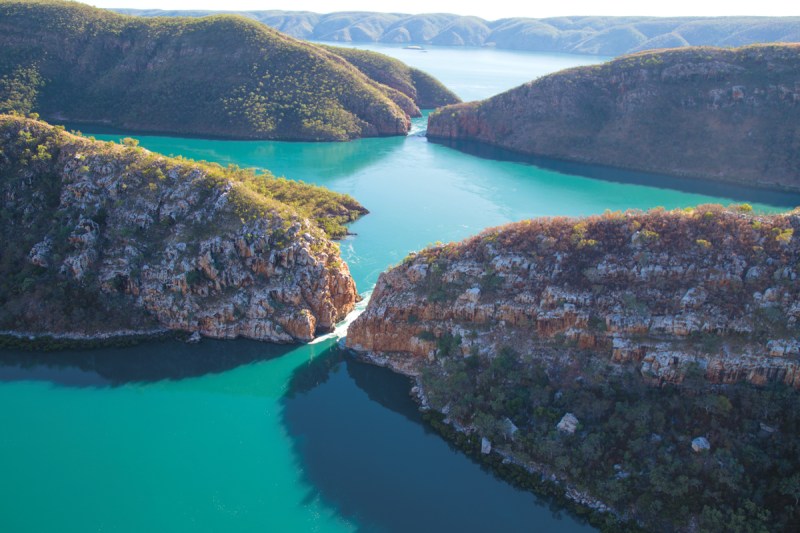
The spectacular and culturally important Horizontal Falls in WA. Photo: Lonely Planet
Garraan-ngaddim (Horizontal Waterfalls), WA
On the north coast of Australia’s Kimberley region, the movement of the tides creates a “horizontal waterfall” through a 300-metre-wide gorge. Known as Garaan-ngaddim, this place has held profound significance for the Dambeemangaddee people, the native title holders of land and sea here, for more than 56,000 years.
“Our ancestors have given us this Country to look after,” explains Leah Umbagai, vice chair of Dambimangari Aboriginal Corporation.
“We want visitors to feel welcome and safe, to see, feel and respect Country the way we do.”
Garaan-ngaddim (‘floating over’) was carved out by the Woongudd woman (spiritual snake) who struck the land with her writhing tail as she moved. Woongudd’s creative powers are active whenever the waters move, and when the tide ebbs she is at rest.
“Our old people, the Woddorda people, would travel between the islands, using the tides to travel,” says Umbagai. “Our old people would only travel through the gaps for a specific purpose and always at the right time: Neap tides, smooth waters, to show respect for Woongudd.”
Garaan-ngaddim is a place for quiet reflection. By visiting respectfully, visitors can listen to what Country reveals to them.
The Dambimangari Aboriginal Corporation is working with the tourism industry on sensitive ways for visitors to experience Garaan-ngaddim. Look for cultural tour guides – the best way to ensure an enriching and sensitive visit – and see inspiration and cultural background on its website.
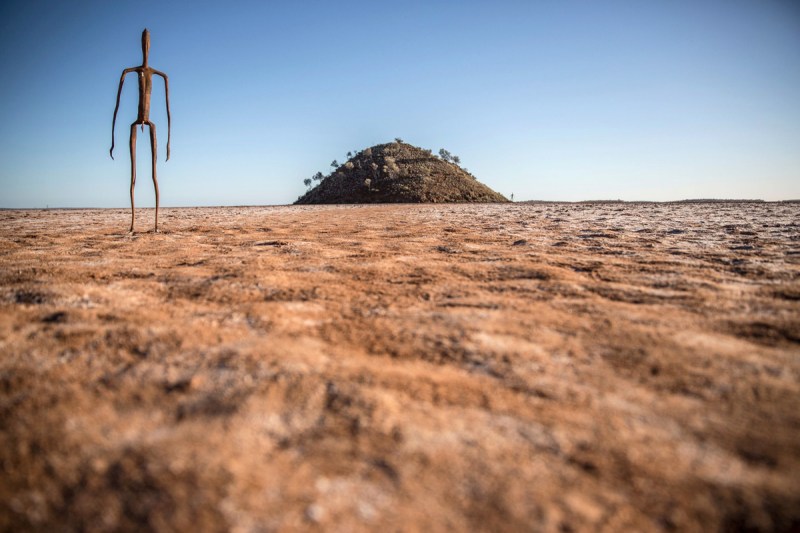
Antony Gormley’s Inside Australia at Lake Ballard. Photo: Tourism Western Australia
Lake Ballard, near Menzies, WA
Lake Ballard is a salt lake, hazy as a mirage under outback sun. In this isolated landscape it’s hard to tell if I’m looking at land or sky, or to imagine who or what made the tracks that meander between solitary figures dotted across the lake’s surface.
These 51 metal statues collectively form Inside Australia, British sculptor Antony Gormley’s representation of the 51 residents of nearby township Menzies.
Walking onto the lake, distance is deceptive. It’s as if the figures are swimming in and out of focus, in and out of reach. Later I return at full moon, adding another perspective to this extraordinary place.
Lake Ballard is 51 kilometres from Menzies by road, and 200 kilometres from the nearest airport at Kalgoorlie.
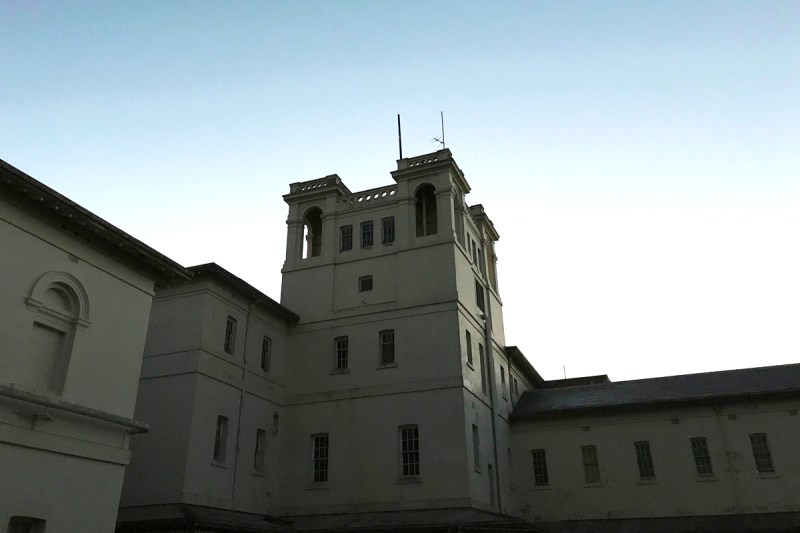
The sun sets on the Aradale Asylum in Ararat, in western Victoria. Photo: AAP
Aradale Asylum, Victoria
Preventing inpatients from escaping can still be aesthetically pleasing, according to the architects of Aradale Asylum.
Modelled after the barracks-style asylums fashionable in 19th-century England, this 70-building complex was established for the care of people with mental illnesses in the then-colony of Victoria.
Italianate features such as campanile towers and archways bestowed a certain elegance, and connecting bridges and arcades were unique design features for an asylum. By building sunken fences around the compound, architects GW Vivian and John James Clark ensured iron-clad security while preserving countryside views (and maintaining the illusion of freedom for unhappy patients).
This psychiatric hospital held hundreds of people, both patients and prisoners, over 126 years before closing in 1993. Though guided tours of the asylum whisper of ghostly sightings, it’s the history of patients’ isolation, and their ability to endure unproven psychiatric ‘care’, that will haunt you long after your visit – note the frantic scratch marks on the inside of wooden doors.

Roam these echoing halls by guided tour. Audience participation (knocking on doors, lying on a mortician’s slab…) is unfortunately mandatory. It’s 2½ hours by road from Melbourne.
Taken from Lonely Planet’s Secret Wonders of the World, $44.99 RRP. Contact shop.lonelyplanet.com
Want to see more stories from The New Daily in your Google search results?
- Click here to set The New Daily as a preferred source.
- Tick the box next to "The New Daily". That's it.
Australia’s coolest neighbourhood

New Aussie bucket-list holiday is a white Xmas