Netanyahu tries to cling onto power with ‘rotating’ PM idea
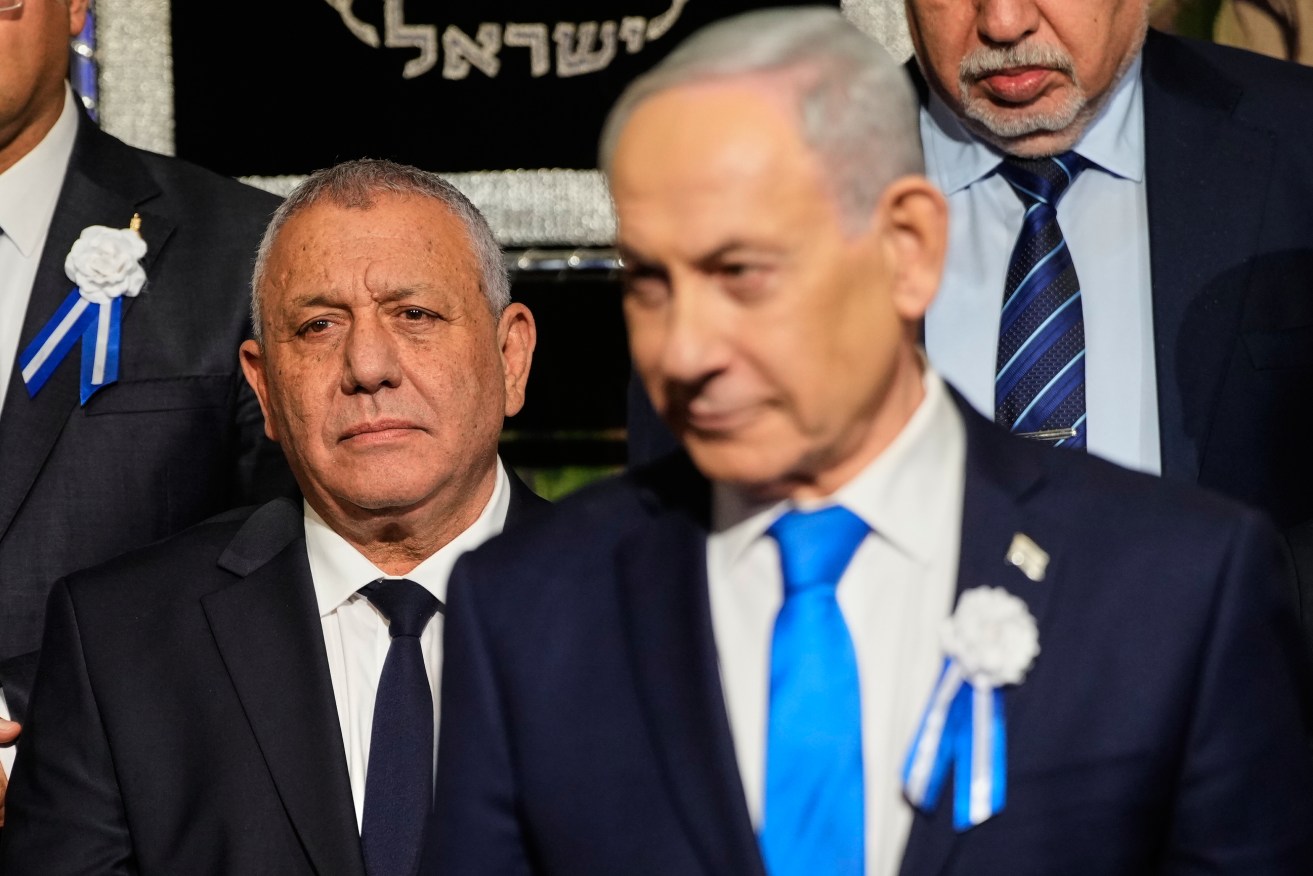
Benjamin Netanyahu says he is willing to have Gadi Eisenkot become prime minister first in a deal. Photo: AAP
Israeli Prime Minister Benjamin Netanyahu’s tenuous hold on the premiership has suffered a setback after discussions over a unity government with Opposition Leader Gadi Eisenkot ended without progress.
Netanyahu was hoping Eisenkot, who is tasked with forming the new government for the deeply divided country after inconclusive national elections, would agree to a unity government if he could be prime minister first in a rotation.
But a two-hour meeting on Sunday (local time), which began with a security briefing, ended without an agreement.
There are no additional meetings planned between Eisenkot and Netanyahu, and the lack of progress does not bode well for Israel’s longest-serving prime minister to stay in power.
Eisenkot will continue trying to build a government without Netanyahu, which he could announce as early as this week.
Parties backing Eisenkot have disagreed over whether to include Arab-led or ultra-Orthodox parties in a potential coalition.
Neither Netanyahu nor Eisenkot’s bloc received the needed 61-seat majority out of 120 Knesset members in The October 27 election, which left both leaders without an easy path toward forming a government.
Eisenkot must form a government by Friday, or request an additional extension until December 20.
But he’s under pressure to announce a new government as soon as possible, because he’s worried that Netanyahu might attempt to drag the country into another conflict with Iran as a tactic for staying in power, said Gayil Talshir, a political scientist at Hebrew University.
“Netanyahu doesn’t know how to lose with respect, and he’s going to fight,” said Talshir.
As Eisenkot has tried to build a government, Netanyahu has pushed to restart the war with Iran over the past few weeks.
He sent his Mossad intelligence chief, Roman Gofman, to meet with CIA officials and top leaders in the US to sway the US to join Israel in attacking Iran, and has frequently mentioned the threat of Iran’s chemical weapons.
American allies in the Middle East have so far stymied his efforts, and the Trump administration, facing bruising losses in the midterms, has been reluctant to restart major combat operations.
Restarting the war would give Netanyahu a boost within Israel, by allowing him to flaunt his military leadership and thrusting Israel into an emergency security situation, freezing political transitions.
“Eisenkot’s central question in terms of security is how to get Netanyahu out of the seat of power as fast as possible so as not to have a political war with Iran,” said Talshir.
-AAP





Trump made $15m with push to reinstate Huang