Premier digs in on Melbourne curfew, offers hope for eased restrictions in regions

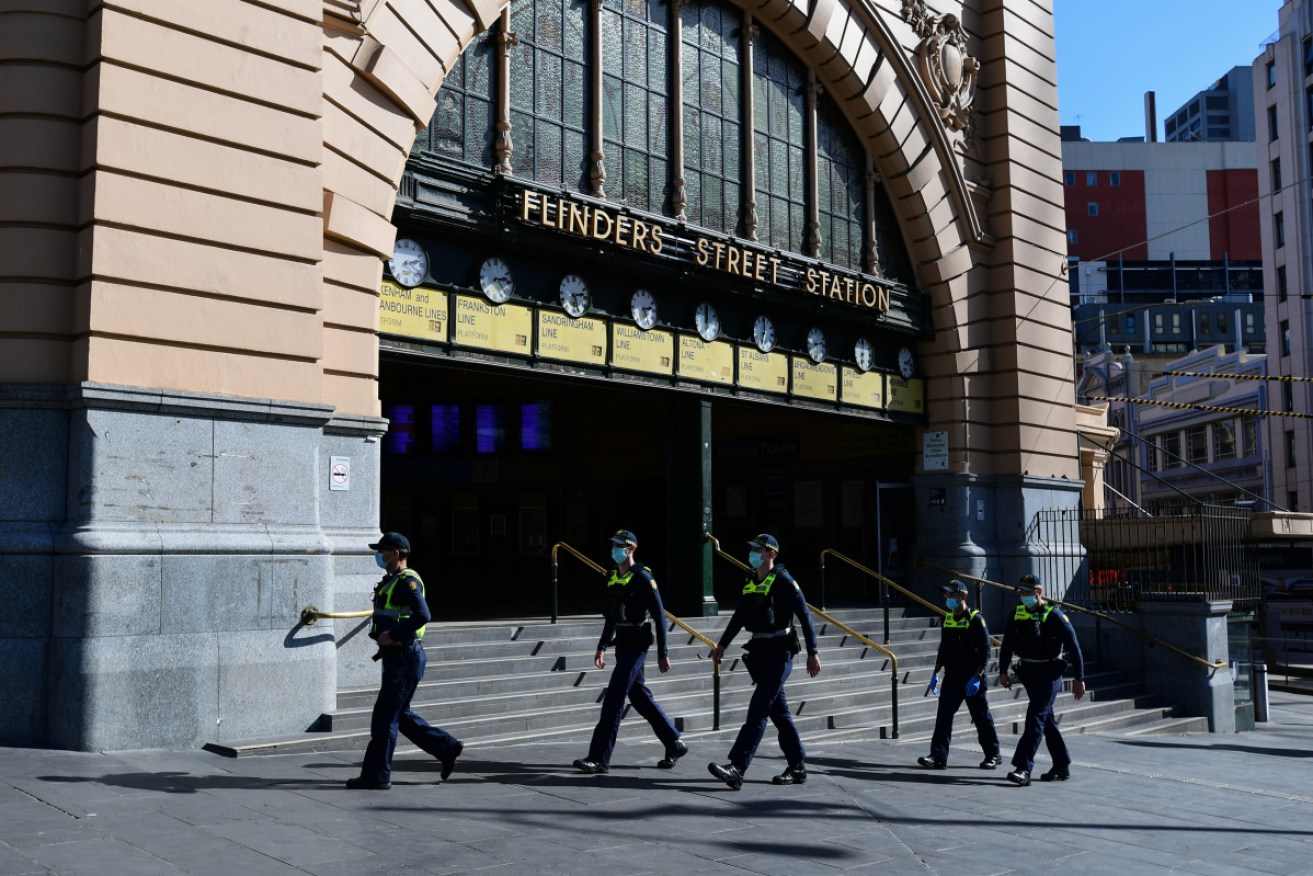
Melbourne's curfew has become one of the most controversial virus measures.
A defiant Victorian Premier Daniel Andrews has backed in Melbourne’s controversial daily curfew, despite it being imposed with no input from police.
The Premier was grilled about the controversial lockdown measure on Thursday, when he also promised regional Victoria was on the cusp of enjoying eased restrictions.
“As it stands now – and I can’t guarantee that this is the case – but if the trend continues, and the numbers are very promising, we’ll be able to take a step, or steps, as early as toward the end of next week,” he said.
Of Victoria’s 51 new COVID cases on Thursday, none were in regional areas. Infections have fallen significantly in country cities that were of concern to health authorities – Ballarat has none, greater Bendigo just two and Geelong has 11.
There are 29 active cases in Colac, in the state’s west, where there has been a second wave of infections sparked by a local’s hospital visit.
The 14-day rolling average of new cases for the state outside Melbourne is 4.5 – it must be below five for regional areas to move to looser virus measures.
“That’s exactly the position that metropolitan Melbourne will get in to. It will take a little bit longer, because the outbreak here is different,” Mr Andrews said.
“It’s the strategy working, and it should be a great reassurance to metropolitan Melbourne that we can get these numbers down. When you get them low, you can keep them low. That’s what’s happening in regional Victoria at the moment.”

Ballarat, which is still under Stage 3 rules, has no active COVID cases. Photo: Getty
Melbourne’s rolling average was at 70.1 on Thursday. It must be between 30 and 50 before restrictions will ease in the city.
Victoria also confirmed seven more fatalities on Thursday, taking its toll from the COVID-19 pandemic to 701.
Elsewhere, Mr Andrews doubled down on the decision to impose a curfew for metropolitan Melbourne, despite police saying they had no input on the move.
The curfew has become another issue for the state government, which is under fire for its “road map” to help Victoria emerge from lockdown.
“I can’t necessarily pinpoint for you the exact individual and the exact moment that it was suggested that we put a curfew on,” Mr Andrews said.
“Anyone who’s displeased with that or doesn’t think that’s a proportionate measure, well, that’s a decision that I’ve made. All these decisions are ultimately decisions that the government has made.”
Earlier on Thursday, Victoria Police Chief Commissioner Shane Patton said police learned a curfew would be imposed on five million Melburnians only when the state government sent them a copy of the guidelines just hours before they were approved.
“The reality is, I was never consulted,” Mr Patton told radio 3AW.
“As best as I can work out, our policy area was provided a copy of the proposed guidelines … a couple of hours before they were signed off.
“We had never requested a curfew.”
Chief health officer Brett Sutton said this week it was not his call to introduce the curfew, which started on August 2 when the state of disaster was declared and Melbourne went into its Stage 4 lockdown.
The curfew will be extended by an hour from Sunday, to run from 9pm-5am, but is not likely to be lifted entirely until October 26. Mr Andrews said it was an effective measure to halt the spread of the virus.
“The notion that the government can’t do anything whatsoever unless the chief health officer provides it in detailed advice, that doesn’t make any sense,” he said.

There is still widespread support for Melbourne’s daily curfew.
Despite the pressure about the curfew, a Roy Morgan survey of 2325 Victorians found 63 per cent supported it.
The survey was conducted earlier this week, five weeks after the introduction of Stage 4 restrictions for Melbourne and only days after Mr Andrews announced a two-week extension to the lockdown.
A similar survey taken a week earlier had support for the curfew at 61 per cent.
Of those surveyed this week, 70 per cent also said they supported Mr Andrews’ work as premier.
Ex-college head wrongly touched junior doctors
Teen suffers horrific burns in alleged arson attack
Magnitude 4.8 quake shakes Victoria
One Nation turns up heat with crime policy