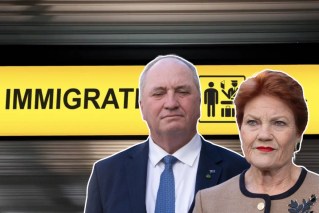
We are in a post-fact world and Hanson is revelling in it

Source: ABC TV
Pauline Hanson wants to increase defence spending by an easy $340 billion a year or so, make it easier to sack workers (who she thinks are lazy), allow pensioners to work as many hours as they want without losing a dollar in their pension (so much for entrenching welfare).
She’ll pay for it by scrapping funding for ABC and SBS (raising about $1.5 billion) and maybe allowing Australia a stake in gas companies when the arse has fallen out of the gas price.
Does any of this matter?
Not to her voters.
And Hanson knows it.
Hanson’s first press club appearance, where she identified as a “proud nationalist” on Wednesday, was a speech worthy of Mar-a-Largo. It was aimed at the same audience.
Previously Hanson would have said she was a “proud patriot”. But in far-right circles, fresh from cheering on a racist pogrom in Belfast, “proud nationalist” is the new term du jour.
A nationalist isn’t proud of their nation, they think that their version of the nation is superior to others. That’s who Hanson is singing to, and it’s a dog whistle that her supporters hear loud and clear.
What is clear is the press gallery is still struggling to get a handle on how to handle Hanson. Unlike the 1990s, the One Nation leader no longer needs the mainstream media – although, like Donald Trump, she still craves its acceptance and approval.
Her social following, and reach through the algorithm means she is free to speak directly to her supporters with as many mistruths, lies and malinformation as she wants. She’s not pressed for details there – no one is asking her what leaving the United Nations would actually achieve, or how Australia is meant to pay for any of the changes Gina Rinehart is urging (and succeeding) in having Hanson adopt and spread across the nation as “common sense”.
Hanson is for the billionaires, cosplaying as working class. She speaks the language and she’s been consistent in her messaging for 30 years.
So, despite the private jets and billionaire playgrounds, Hanson isn’t tarred by the hypocrisy. She is able to turn up to towns with almost no public notice and speak to crowds with no outside eyes and ears – which she can do, because regional media has been mostly gutted, shut down by the majors who saw no need to know what was happening in communities outside of cities.
Guardian Australia’s Sarah Martin has been outstanding in reporting on what is happening within and around One Nation. But she has been largely alone in breaking the insider news Hanson and acolytes don’t want broken.
That’s part and parcel of how homogenous media has become and the impact of having such a city focus. Many journalists covering One Nation would never have met a One Nation voter and it shows. The ones who have have more than likely met one of the corporate supporters who see opportunity galore in what Hanson offers – reasserting their dominance and control, but with added bonuses of less regulation and taxes. It has ever been thus.
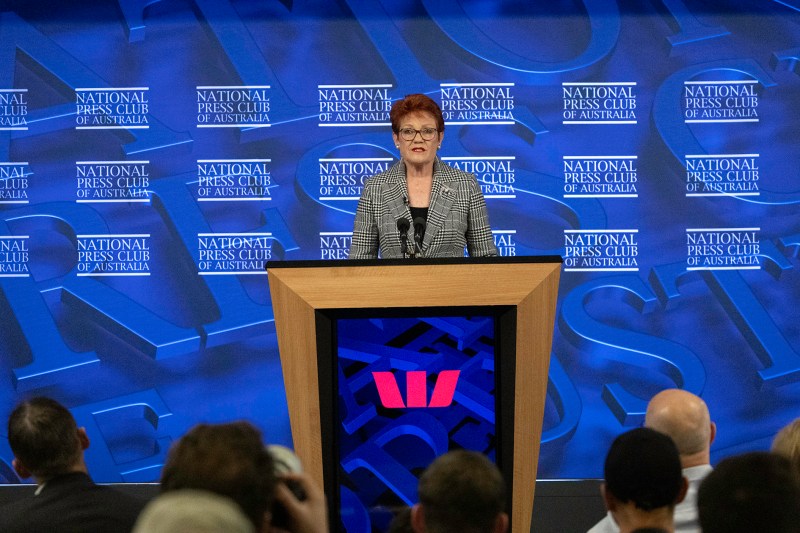
Social media has extended Hanson’s reach far beyond the press gallery. Photo: Mike Bowers
There will no doubt be endless factchecks of Hanson’s speech (if someone could check it for a fact, that would be a great start) but it won’t matter. We are in a post-fact world and Hanson, like Trump, like Nigel Farage, and like Joh Bjelke-Petersen before her, excels in that environment.
It doesn’t matter that 25 per cent of the population does not speak Chinese or Arabic, as Hanson claims (the true figure, according to the last census is about 4 per cent) – Hanson knows her clip will travel faster than any truth.
So what to do? Former Fairfax press gallery journalist Margo Kingston wrote THE book on Hanson in the 1990s and has watched her most recent rise with the wisdom of someone who knows that everything old is really truly new again. It’s been enough to get her back into writing. Kingston watched Hanson’s speech with a sense of prescient deja vu.
“You could argue that politics is now at the grassroots, and people who don’t agree with her (Hanson) have to find a way to discuss these issues with people who do agree with her,” Kingston told this column.
Hanson’s appeal hasn’t changed, Kingston warns, but her reach has – it goes further. And, she builds respect by constantly showing up.
“You can say what you want about Hanson, but she went out to all-comers,” Kingston said.
Which is something she saw John Howard notice, and embrace in pushing back:
“I go right back after the Queensland election [in 1998] and, to his credit, John Howard went to three seats that elected One Nation and the first one, I was with him. It was meeting angry pig farmers in Gympie or somewhere similar. And he took it. He disagreed with them, he explained why. They were very angry but they walked out respecting him.”
All politics, as Kingston knows, is local. And Hanson wins the locals time and time again.
Now, those locals are close to people who have never considered Hanson a serious electoral threat. But so are those who have the answer.
Hanson’s supporters won’t listen to factchecks or policy, or even the mainstream media. But they will probably listen to their community.
That doesn’t mean agreeing with her, but it does mean taking what she is saying seriously. Because your neighbours are. And you need to know what conversations to have.
Amy Remeikis is a contributing editor for The New Daily and chief political analyst for The Australia Institute
Want to see more stories from The New Daily in your Google search results?
- Click here to set The New Daily as a preferred source.
- Tick the box next to "The New Daily". That's it.

Voters want truth in political ads. Will pollies listen?