
The United Nations chief says aid agencies are at “breaking point” and face “total collapse” as he used a rare power to urge a ceasefire ahead of an emergency vote on Gaza.
The UN Security Council is due to vote on Saturday (AEDT) on a resolution demanding an immediate humanitarian ceasefire, drafted by the United Arab Emirates.
Before the vote, UN secretary general Antonio Guterres used a special power — invoking Article 99 — to inform the council of matters he believes threaten international peace and security.
The last time it was invoked was in 1989 during Lebanon’s civil war.
“I wrote to the Security Council invoking Article 99 because we are at a breaking point,” said Guterres.
“There is a high risk of the total collapse of the humanitarian support system in Gaza, which would have devastating consequences.
“We anticipate that it would result in a complete breakdown of public order and increased pressure for mass displacement into Egypt.
“I fear the consequences could be devastating for the security of the entire region.”
Guterres described a “spiralling humanitarian nightmare” in Gaza, with 17,000 Palestinians reportedly killed and nowhere to go for those still alive.
Guterres said Palestinians were being told to move “like human pinballs – ricocheting between ever-smaller slivers of the south, without any of the basics for survival”.
“But nowhere in Gaza is safe,” he added, saying the agency itself had lost more staff in Gaza than any previous conflict.
“More than 130 of my colleagues have already been killed, many with their families.
“This is the largest single loss of life in the history of our organisation.
“Some of our staff take their children to work so they know they will live or die together.”
Guterres said of the 17,000 Palestinians reportedly killed, more than 7,000 were children and 4,000 were women.
“Tens of thousands are reported to have been injured, and many are missing, presumably under the rubble.
“Over 60 percent of Gaza’s housing has reportedly been destroyed or damaged – some 300,000 houses and apartments.
“Some 85 percent of the population have been forced from their homes.”
Ceasefire vote
Guterres’s words came as the UN Security Council delayed the ceasefire vote until after a planned meeting between Arab ministers and US Secretary of State Antony Blinken.
The United States — a veto-wielding power on the council — has said it does not currently support further action by the 15-member body.
The US and Israel oppose a ceasefire because they believe it would only benefit Hamas.
The US instead supports pauses in fighting to protect civilians and allow the release of hostages taken by Hamas in a deadly October 7 attack on Israel.
The council last month called for pauses in fighting to allow aid access.
“While the United States strongly supports a durable peace, in which both Israelis and Palestinians can live in peace and security, we do not support calls for an immediate ceasefire,” deputy US ambassador to the UN Robert Wood told the council.
“This would only plant the seeds for the next war because Hamas has no desire to see a durable peace,” he said.
To be adopted, a Security Council resolution needs at least nine votes in favour and no vetoes by the five permanent members — the United States, Russia, China, France or the United Kingdom.
Tweet from @UNWebTV
While the vote was delayed, the council still convened on Friday morning to hear a briefing by Guterres after he made a rare move on Wednesday to formally warn of a global threat from the war.
“I urge the council to spare no effort to push for an immediate humanitarian ceasefire, for the protection of civilians and for the urgent delivery of lifesaving aid,” Guterres said.
Israel’s UN ambassador Gilad Erdan said there had been a ceasefire that was broken by Hamas on October 7.
“The irony is that regional stability and the security of both Israelis and Gazans can only be achieved once Hamas is eliminated, not one minute before,” Erdan said.
“So the true path to ensure peace is only through supporting Israel’s mission — absolutely not to call for a ceasefire.”
Gaza bombarded
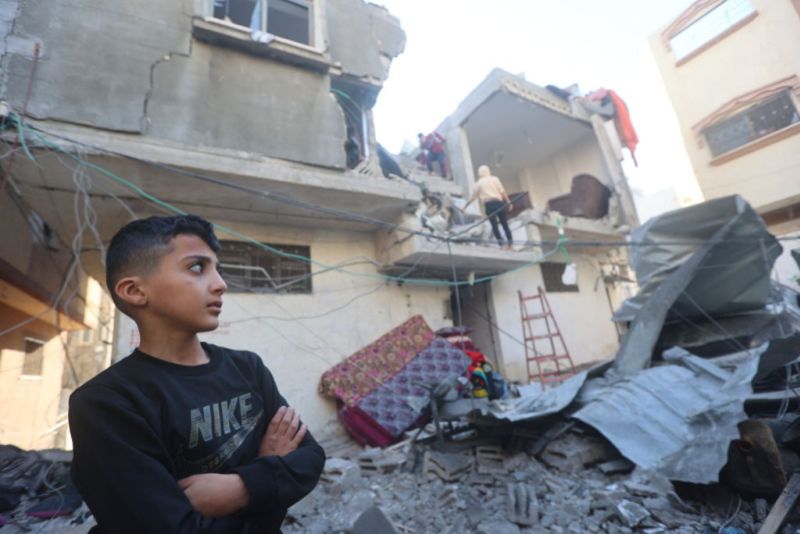
An Israeli bombardment on Khan Yunis in the southern Gaza Strip. Photo: Getty
Israel sharply stepped up strikes on the Gaza Strip on Friday, pounding the length of the Palestinian enclave and killing hundreds.
The Israeli military said it had struck more than 450 targets in Gaza from land, sea and air over the past 24 hours – the most since a truce collapsed last week and about double the daily figures typically reported since then.
With most Gazans displaced and unable to access any aid, hospitals overrun and food running out, the main UN agency there said society was “on the verge of a full-blown collapse” and its ability to protect people there was “reducing fast”.
Residents and the Israeli military both reported intensified fighting in both northern areas, where Israel had previously said its troops had largely completed their tasks last month, and in the south where they mounted a new assault this week.
Gaza’s health ministry reported 350 people killed on Thursday, bringing the death toll from Israel’s two-month campaign in Gaza to 17,487, with thousands more missing and presumed buried under rubble.
More strikes were reported on Friday morning in Khan Younis in the south, the Nusseirat camp in the centre and Gaza City in the north.
Israel’s military said 94 Israeli soldiers had been killed fighting in Gaza since its ground invasion of the enclave began.
An Israeli commander, Brigadier General Dan Goldfuss, said in a video message recorded in Khan Younis that his forces were fighting house to house and “shaft to shaft,” a reference to tunnel shafts.
-with AAP