‘OG of mapping’ surges after defying Trump’s lake name change

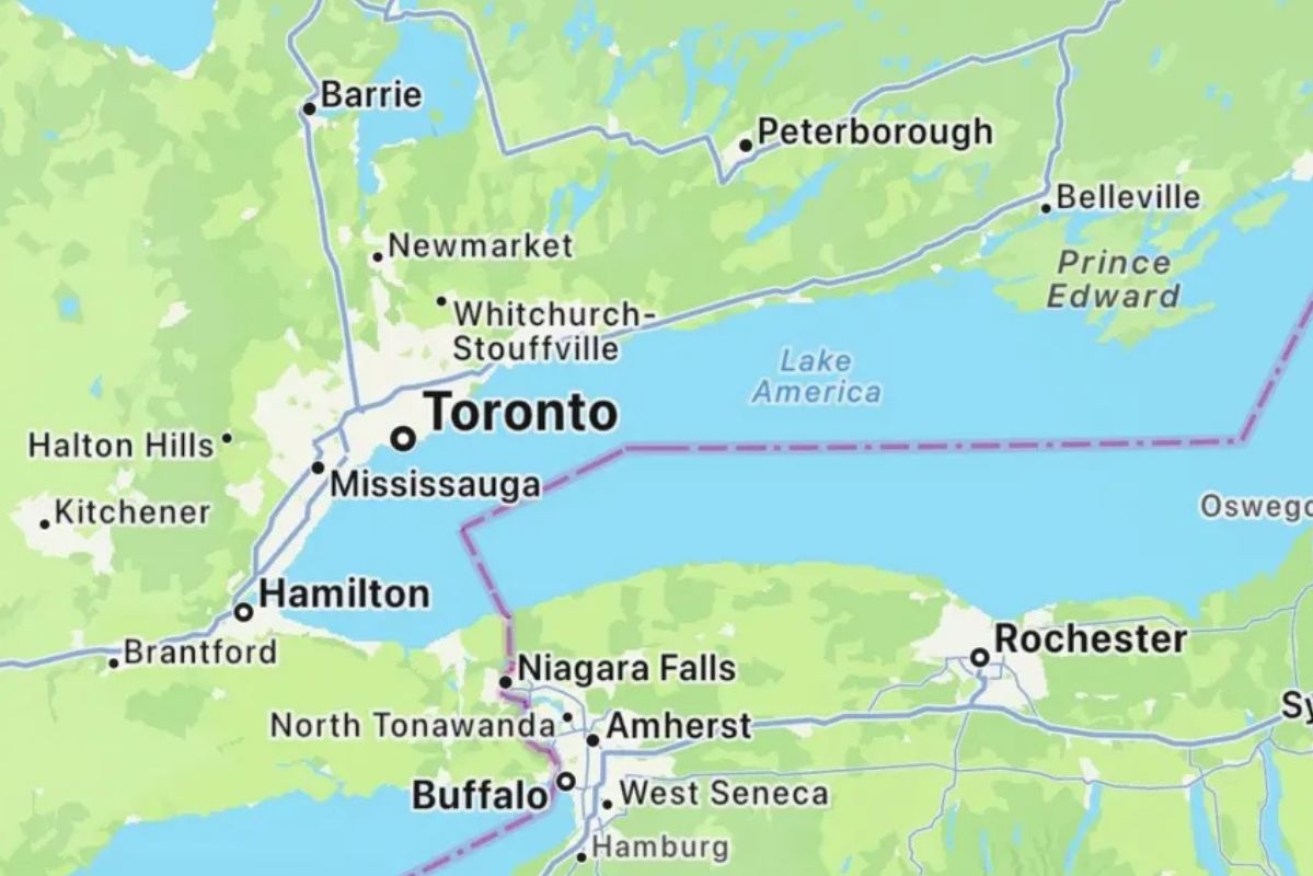
Apple this week followed rival Google in changing the Great Lake's name. Image: Apple
A 30-year-old app has surged back to the top of Apple’s rankings after defying US Donald Trump’s Lake Ontario name switch.
“We’re not changing it,” MapQuest posted to X in the hours after Trump last Thursday ordered the smallest of North America’s five Great Lakes to be called “Lake America” as his trade war with Canada escalated.
MapQuest general manager Doug Berger said the company – which calls itself “the OG of online mapping” – did exactly what it did in 2025 when Trump unilaterally redesignated the Gulf of Mexico as the Gulf of America.
“Be part of the conversation, and give people an app that keeps the names they’re familiar with,” he said.
“Hundreds of thousands of people signalled to us this weekend that we got it right by downloading our app.”
MapQuest has also released an online tool that lets users jokingly rename Lake Ontario to whatever they want it to be, then share the results on social media. It also offered a similar tool last year, after Trump renamed the Gulf of Mexico.
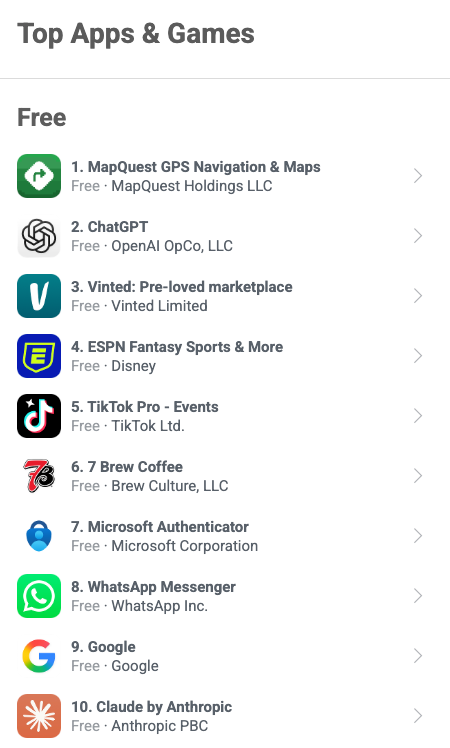
By Monday (US time), hundreds of thousands of people had downloaded MapQuest’s apps in the days after last Thursday’s White House announcement. Usage leapt to about 50 times normal.
MacRumors reported MapQuest was the top free iPhone app in Canada and No.4 among free US apps, excluding games.
TechCrunch said it reached No. 1 in US navigation. It cited Sensor Tower data that showed more than 160,000 American downloads in the week starting August 24, more than 10 times the prior week.
“People spoke with their downloads,” Berger told Business Insider. “They want a mapping app with names they’re familiar with.”
Source: AppFigures
Trump’s renaming decision affects the US Geographic Names Information System, which sets the standards for official US maps. It has no impact on Canadian naming conventions or how the rest of the world refers to Lake Ontario.
It was also quickly rejected by Canadian authorities, including Prime Minister Mark Carney, as well as some governors on the lake’s US shores.
Despite that, the big mapping apps quickly fell into line. Google said at the weekend it had switched its Maps app to “Lake America” for US users. It follows a similar change for the Gulf of Mexico last year.
“Since we update Google Maps to reflect name changes in official government sources, which is GNIS for the US, people using Maps in the US will see ‘Lake America’, those in Canada will continue to see ‘Lake Ontario’, and those outside of the US and Canada will see both names,” the company said.
Apple held out for longer, before eventually making the switch for American users on Tuesday. It reportedly came after Trump contacted the tech giant.
“I know that the President reached out to Apple directly, so I’m sure that we may be seeing that change coming up soon to Lake America,” US Interior Secretary Doug Burgum told the Fox Business Network’s Mornings with Maria on Monday.
Apple – whose changes mirrored those at Google – confirmed the switch to Reuters.
MapQuest, meanwhile, has stayed strong.
The company – which is old enough to have once required users to print out its directions. Launched in 1996, it was one of the web’s first mapping applications and has tens of millions of users a month.
But the company lost traction with the rise of GPS devices in cars as well as its big-tech rivals at Google and Apple.
“MapQuest is that girl,” one TikTok user said, applauding the company for “having a backbone”.
“Let me go ahead and download the app,” another user wrote. “MapQuest, I’m sorry girl … I was unaware of your game … How dare I ever disrespect you.”
Others weren’t as generous.
“Shocking to see you’re still alive… I thought the iPhone 3 took you out 15 years ago,” one of the President’s sons, Eric Trump, wrote.
The Seneca Nation — one of the six nations of the Haudenosaunee, or Iroquois, Confederacy — has urged Trump to rescind the name change.
Senaca Nation President J. Conrad Seneca said it violated the terms of a 1794 treaty signed with US president George Washington that laid out the Senaca Nation’s boundaries as “beginning on Lake Ontario”.
“The President cannot assert ownership over our culture or erase it through irresponsible political action,” Seneca said.