Australia’s largest telco is blaming a software defect for the crippling outage that caused nationwide disruptions, potentially affecting millions of phone-users, travellers and shoppers.
Telstra, the $56 billion giant that powers about 25 million Australian mobile services, said its network issues had been fully resolved by 4pm on Wednesday after an outage that began in the early morning.
Pervasive network problems left users unable to make calls or access data on their mobile phones, while some EFTPOS transactions were also affected.
Telstra chief financial officer Michael Ackland said the telco was continuing to investigate but it was confident its teams had identified and isolated a software defect.
However, he revealed potential triple-zero call problems were more widespread than previously thought, requiring hundreds of welfare checks.
By Wednesday afternoon, Telstra had completed 333 checks on customers who made an emergency call that was unsuccessful or dropped out after connecting.
“The volume of these welfare checks was higher than we expected and it has prompted us to investigate further,” Ackland said.
Investigations into the underlying cause of the software glitch were ongoing.
“The fact that it occurred means that there is something in our process that we need to fix and to change – we are working through that,” the Telstra executive said.
Communications Minister Anika Wells said the problem was different to past failures, including an Optus outage in September that was linked to multiple deaths.
“This is not a triple-zero outage,” she said.
“This is a Telstra retail outage that has affected their customers right across the country.”
Small businesses having troubles with failing EFTPOS transactions was “incredibly frustrating”, Wells said.
The outage brought freight and regional train networks to a halt and hampered payment systems crucial to small businesses.
Wells acknowledged the outage would test Australians’ patience with telcos as the communications watchdog and the custodian completed investigations.
“Australians expect a baseline of services when it comes to their telcos,” she said.
“There’s a reason telcos are the least trusted industries in Australia – it’s because of days like today.”
But opposition communications spokeswoman Sarah Henderson described the government’s response as “totally inadequate”.
“Australians are still waiting for the outcome of ACMA’s inquiry into the Optus triple-zero outage last September but all we have heard is silence,” she said, calling on the watchdog to file its report within seven days.
Henderson is under fire for repeatedly calling triple-zero during Wednesday’s outage to “test” if the calls would connect. Misuse of the emergency call network is potentially a criminal offence punishable by up to three years’ jail, but Henderson has denied any wrongdoing.
Henderson said the law related to “vexatious or hoax calls”.
“I was clearly concerned about the wellbeing and safety of Australians,” she said.
“The bottom line is I’m doing my job and I don’t have trust in this government and I have very low trust in our telecommunications carriers after what we saw last year [with the Optus outage].”
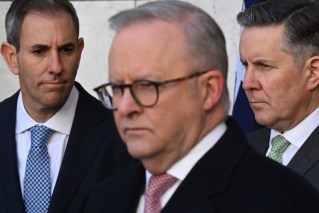
Opposition Leader Angus Taylor earlier drew a link between the outage and a recent Chinese missile test, although he did not provide any evidence to support the suggestion.
“We saw a provocative and unwelcome missile launch from the [People’s Liberation Army] yesterday and I can understand why Australians are drawing that connection,” he said.
One Nation MP Barnaby Joyce also aired similar accusations.
Wells and Emergency Management Minister Kristy McBain have criticised Henderson and Taylor.
“We teach our kids not to prank call triple zero, and I think it is absolutely outrageous that the shadow communications minister has been making test calls to triple zero at a time where we need to make sure that we are doing as many welfare checks as possible and making sure that that network is open to people in emergency situations,” McBain said.
Wells said Telstra had said there was no evidence foreign interference was behind the damaging outage.
“As a general principle, I think when it comes to matters of national security, you shouldn’t make stuff up,” she said.
“As of today, there is no current evidence … apart from two parliamentarians going off half-cocked, to be honest.”
The outage affected triple-zero calls in Western Australia, according to police there.
It also forced the Australian Rail Track Corporation to suspend freight services along its rail lines across the country.
The outage brought all of Victoria’s regional train services to a halt. They were still experiencing issues on Thursday morning.
Across the border, Transport for NSW said some regional train services in the Hunter region and south-west of Sydney were not running, causing cancellations and delays into Wednesday night.
Swinburne University transport expert Hussein Dia said the outage should prompt a broader conversation about building more resilient transport networks.
“As transport networks become more digital and connected, they need communications systems that can tolerate faults without bringing an entire network to a standstill,” he said.
EFTPOS machine company Tyro also reported hampered transactions.
At its peak, more than 7000 customers reported the network disturbance on online monitoring platform Downdetector.
The latest outage comes after other telecommunications giants Vodafone and Optus previously experienced major network disruptions.
—with AAP