Unravelling the mystery: Earth’s oldest crater is in WA
Source: Curtin University
Clever detective work by scientists has identified the Earth’s oldest known asteroid impact crater in the Western Australian outback, dating it to three billion years ago.
Curtin University researchers investigated rock formations at the North Pole Dome in the Pilbara region, a site long suspected to be an ancient asteroid impact structure.
Using advanced mineral dating techniques, the team found evidence the impact occurred about three billion years ago. The finding upends a previous belief the crater was nearly 3.5 billion years old but leaves it still holding its title of world first.
The planet’s next-oldest known meteorite impact crater — the Yarrabubba impact structure – is also in WA. It is thought to be about 800 million years newer.
The Pilbara is home to some of the oldest rocks on Earth.
“While the site had previously been identified as an ancient impact structure, its exact age remained uncertain,” lead researcher Chris Kirkland, from WA’s Curtin University, said.
“The impact left a ‘mineral clock’ behind. By dating minerals that were remade or newly grown in the damaged rocks, we can now pin down when this extraordinary event happened.”
Kirkland said the key evidence came from zircon – “a tiny but extraordinarily resilient mineral that can keep geological time for billions of years.”
Some of the examined zircon had unusual branching, interpreted as crystals modified during the intense heating caused by the impact.
“These zircon crystals record an event at about three billion years ago, which we believe is the best estimate for the impact,” Kirkland said.
To confirm the result, the team analysed a second mineral, apatite, which formed as hot fluids moved through the shock-damaged rocks, and this independent dating method produced the same age.
“The agreement between two different mineral systems gives us confidence that we are seeing the signature of a single major event – a meteorite impact,” Kirkland said.
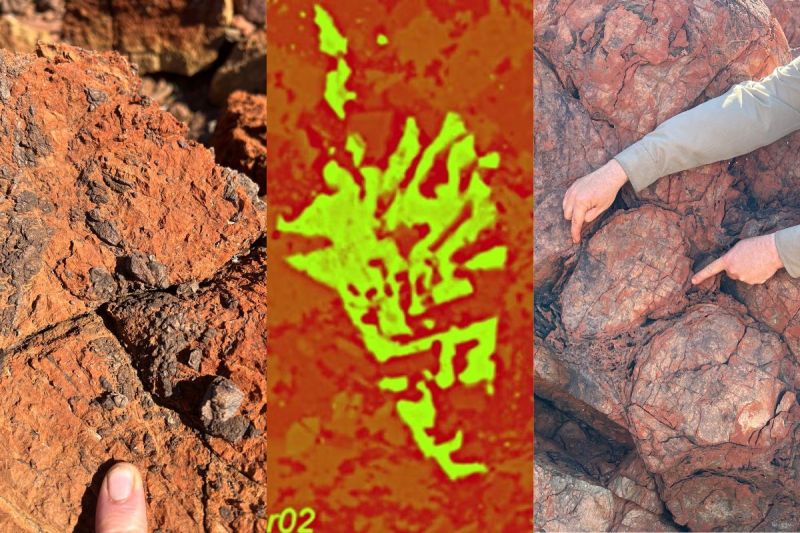
The team found zircon crystals recorded an impact about three billion years ago. Photos: Curtin University
Their findings were published in Geology. The dating places the North Pole Dome structure as Earth’s oldest known impact crater and the only recognised example from the Archean eon, a time when the planet’s earliest continents were forming.
The asteroid is believed to have landed in what was then ocean, Kirkland said.
Scientists believe there were early life forms on Earth at that time in the form of stromatolites, layered sedimentary rocks built by ancient micro-organisms.
“Ancient impact craters are incredibly difficult to date because over billions of years, rocks are altered by heat, pressure and fluids, which can obscure or reset the original impact signals,” Kirkland said.
“The new age places the North Pole Dome structure as Earth’s oldest known impact crater [from] a time when the planet’s earliest continents were forming.”
Scientists have yet to determine the size of the North Pole Dome asteroid or of the crater.
Kirkland said WA was one of the few places on Earth where deep time capsules in the rocks allowed scientists to peer into the processes that formed the surface of the planet.
-AAP
Want to see more stories from The New Daily in your Google search results?
- Click here to set The New Daily as a preferred source.
- Tick the box next to "The New Daily". That's it.