Clayface tries to combine comic-book action with the success of body horror


Clayface is centre stage in a supervillain origin story, with a generous helping of body horror. Photo: Warner Bros
Several characters have worn the mantle of the villain Clayface in DC comics across eight decades, but the two most prominent must surely be Basil Karlo and Matt Hagen.
Karlo, the first Clayface, who debuted in June 1940, was a B-movie actor who had no superpowers but did have a thirst for blood and a penchant for crime.
In the 1950s Batman adventures, Clayface reappeared in the shape of Matt Hagen, a treasure hunter whose accidental encounter with radioactive material gave him the power to transform into a lumbering mass of muddy goo with superhuman strength and the ability to shapeshift into any likeness.
Other comic book versions of Clayface have come and gone over the decades, but for his big screen debut DC has opted to bring back Matt Hagen once again.
This time Clayface is centre stage in a supervillain origin story, with a generous helping of body horror – a sub genre that has enjoyed renewed popularity in recent years.
In the film’s contemporary reimagining, Hagen is a Hollywood actor whose career high is ended when his face is brutally disfigured by mobsters in revenge for sleeping with their gang boss’s girlfriend.
A desperate Hagen decides to put himself forward as a human guinea pig for the testing of an experimental formula containing microscopic AI.
This treatment promises to regrow damaged cells and repair the body to its original form. At first the results are promising, but then, in response to emotional excitement – especially anger – his flesh begins to warp and take on an unpredictable life of its own.
Following the comics, Hagen learns to shift his malleable face to mimic others. He uses these new abilities in a gory revenge rampage on the gangsters that assaulted him and wrecked his career.
While Clayface doesn’t live up to its genre-bending promise of a comic book body horror, it’s not an unmitigated disaster. The film is entertaining and features enough imaginative sequences to forgive some of its more prosaic and one-dimensional aspects.
I was excited at the prospect of a supervillain story from writer and director Mike Flanagan. The horror impresario is responsible for some brilliant recent adaptations, including the peerless Haunting of Hill House for Netflix.
I was also hugely impressed with his risk-taking, imaginative update of Stephen King’s debut novel Carrie.
However, Flanagan stepped back from the lead writing role – likely because of scheduling conflicts with Carrie.
He retains a co-writing credit. But there’s little in this film that recalls Flanagan’s sensitivity for character and the nuanced dialogue of his best work.
A full rewrite by British-Iranian screenwriter Hossein Amini (the excellent Drive, the not-so-excellent The Snowman) may be partly responsible for the film’s tonal uncertainty and an oddly noncommittal feel to much of the action.
The finished product seems to be grappling with the daring originality of its premise and the need for mainstream appeal.
A strong lead for thin material
That said, Clayface’s lead, Welsh actor Tom Rhys Harries, carries the weaker aspects of the script extremely well with an admirable commitment to his character’s horrific transformations.0
The film’s best scenes show Hagen confronting what could either be seen as an exciting new body with superhuman abilities or a terrifying total degeneration.
Harries’ energetic performance produces some memorable sequences where Hagen wrestles with his unruly body, the best of which features a battle to keep his dysfunctional, goopy eyelids from sealing shut.
Prosthetic effects are blended effectively with CGI – and horror fans should enjoy the effort and commitment from both the actor and the effects crew.
There are distinct shades of Coralie Fargeat’s outrageous and brilliant mainstream body horror breakthrough The Substance (2024).
Clayface shares that relentlessly gory film’s interest in the shallow vanity of celebrity and the lengths the protagonist goes to in order to preserve youth and beauty in a skin-deep world.
Also, the connection between Hagen’s emotional state and his progressively warping flesh results in an interesting exploration of male mental health and its impact on the physical body. That a supervillain origin story tackles these kinds of themes is in itself quite admirable.
Clayface also has strong echoes of David Cronenberg’s masterful and influential piece of body horror The Fly (1986). In this classic, Jeff Goldblum’s scientist accidentally splices his DNA with that of a housefly. His transformation begins as a thrilling set of new abilities before becoming a full bodily breakdown into a grotesque creature.
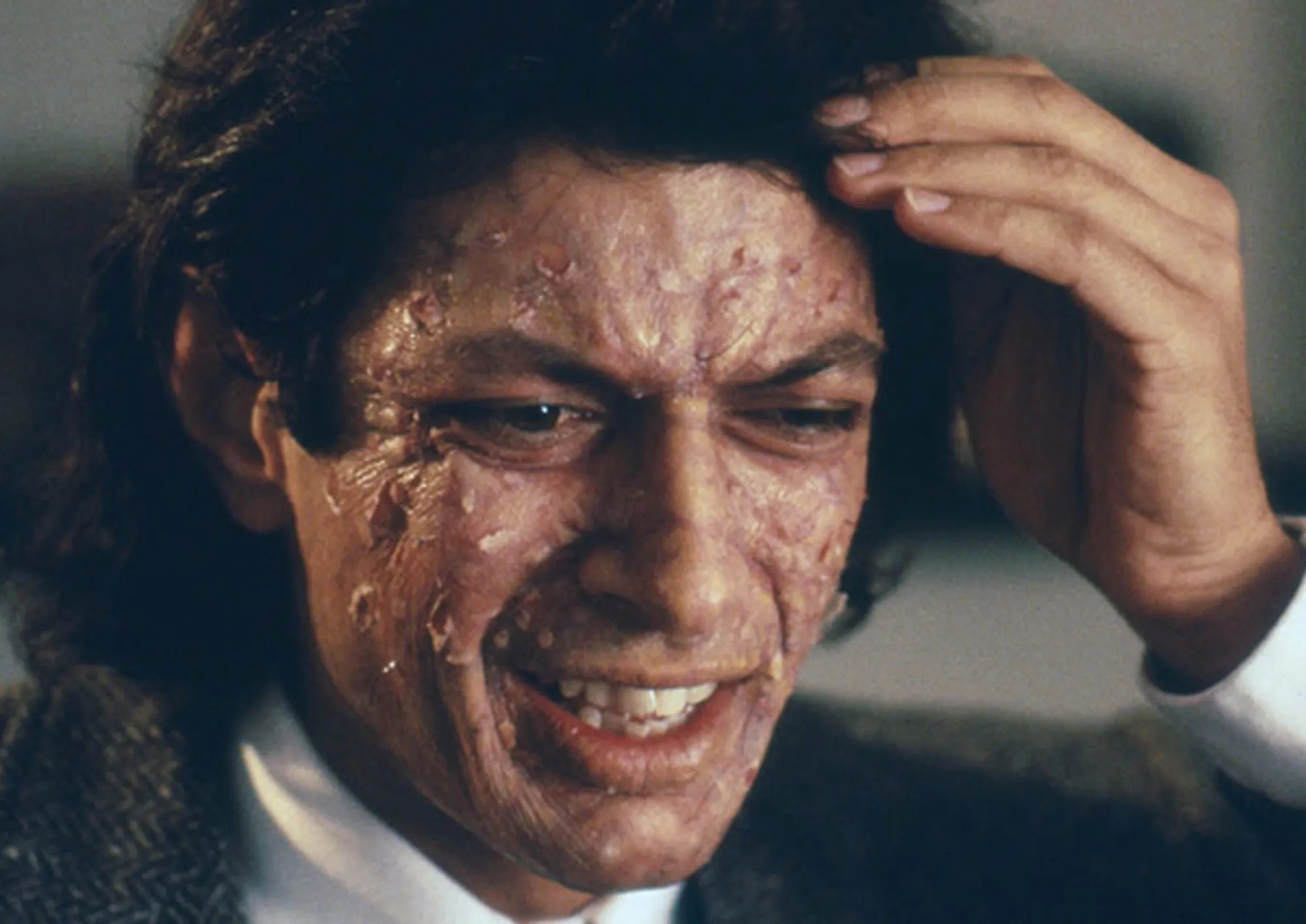
Clayface has echoes of ’80s classic, The Fly. Photo: 20th Century Fox
Clayface aims to tread similar terrain, but simply can’t replicate Cronenberg’s ability to walk the line between terror and wonder at the body’s strange transformations.
The main obstacle to Clayface’s success, however, is the surface-level characterisation and very basic sketching of the supporting ensemble of cliched and cartoonish mobster types.
This is most glaring in the eye-rolling love story thrown in to encourage emotional connection with the central characters.
This is something The Fly managed to pull off around the horror as scientist Seth Brundle (Jeff Goldblum) and science journalist Veronica “Ronnie” Quaife (Geena Davis) fall in love and try to defy the odds stacked against them.
Theirs is an incredibly convincing performance of chemistry, which was certainly helped by the fact the two actors were dating. Sadly, Clayface just can’t replicate it.
While Clayface’s goriest sequences are full of the imaginative horror that only an enthusiast of the genre could conceive, its dialogue and character remains thin. The movie offers neither the emotional nuance typical of Flanagan at his best nor leans knowingly into the over-the-top tropes of gangsters or the mythology of the comics.
Instead, Clayface falls in a passable middle-ground that may be overly tame for horror fans accustomed to the wild spectacles of Fargeat and Cronenberg’s work while also being overly icky and violent for comic book film fans.
Matt Jacobsen is senior lecturer in film history at Queen Mary University of London