 Subscribe

Trust tax changes explained: How the new rules affect your hip pocket
A proposed tax overhaul could leave family trusts paying thousands more, with small businesses facing tough choices over how they distribute income.

- The government wants to impose a minimum 30 per cent tax on most discretionary trust income from July 2028.
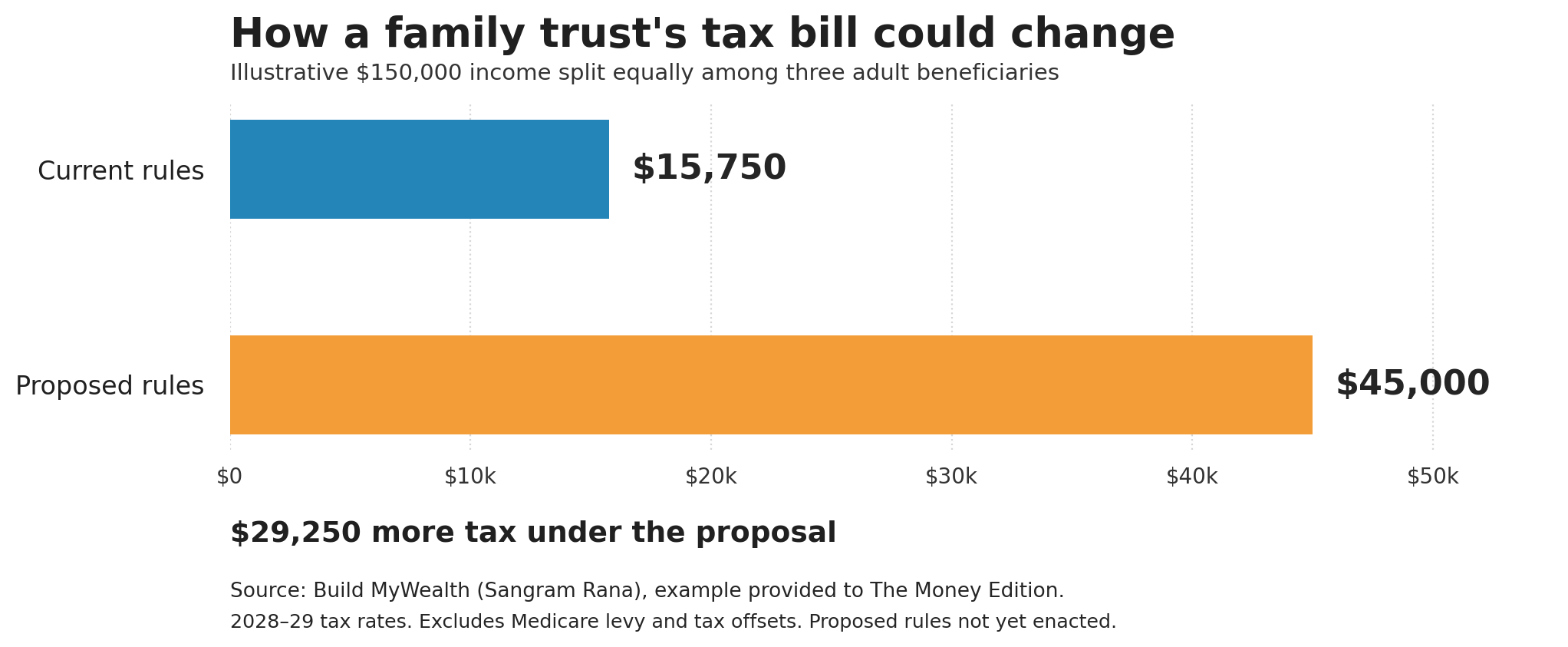
- In one example, a family’s tax bill on $150,000 in trust income would rise from $15,750 to $45,000.
- Treasury estimates 210,000 small businesses could be affected annually, with some facing costly restructuring decisions.
Hundreds of thousands of Australian families and small businesses could face higher tax bills under a proposed overhaul of discretionary trust rules.
The Albanese government has introduced legislation to impose a minimum 30 per cent tax on most discretionary trust income from July 2028.
It says the changes will make the tax system fairer, but experts warn some family businesses could face higher bills or costly decisions about how they operate.
A discretionary trust, often called a family trust, allows a trustee to hold assets or run a business for others, usually family members.
These people are called beneficiaries, and the trustee decides each year how much income each receives.
For example, a couple might run their business through a trust and distribute its profits between themselves and their adult children.
Julie Abdalla, head of tax and legal at The Tax Institute, said trusts let families distribute income flexibly, manage wealth across generations, and provide some asset protection, though that protection isn’t guaranteed.
Treasury estimates Australia has around 840,000 discretionary trusts, including 350,000 used by small businesses.
How are discretionary trusts currently taxed?
Under current rules, a trust generally doesn’t pay tax on income it distributes to beneficiaries. Instead, each beneficiary pays tax at their individual rate.
Because lower-income earners generally pay less tax, families can reduce their combined tax bill by distributing income to lower-earning adults, such as a university student or a non-working spouse. This is known as income splitting.
Sangram Rana, principal financial adviser at Build MyWealth and a registered tax agent, gave The Money Edition an example of a family business earning $150,000.
If the trustee distributes $50,000 each to Mum, Dad, and their 19-year-old university student, and none has other income, each will pay $5,250 in tax.
That’s $15,750 for the family, compared with $36,300 if Dad earned all $150,000 himself.
The example uses 2028–29 tax rates and excludes Medicare levy and tax offsets.

What is the government proposing?
From July 2028, most discretionary trust income would face a minimum tax rate of 30 per cent, regardless of who receives it.
The government argues this would make the system fairer by reducing the tax advantages of income splitting.
“A worker earning a salary pays tax at their own marginal rate, with no ability to share that income with family members,” The Tax Institute’s Abdalla said.
Under the proposal, the trust would pay 30 per cent tax upfront. Beneficiaries would receive a credit for tax already paid but couldn’t get a refund if it exceeded their personal tax bill.
Take the same family business earning $150,000. The trust would first pay $45,000 in tax, leaving $105,000.
For tax purposes, the income would still be divided equally among the three family members. Each would be treated as having earned $50,000 and would normally owe $5250 in personal income tax.
But because the trust has already paid tax on that income, each person would receive a $15,000 tax credit – their share of the $45,000 already paid.
That credit would cover their $ 5,250 tax bill, so they would pay no further tax. However, the remaining $9750 couldn’t be refunded.
So the family would pay $45,000 in total tax, compared with $15,750 under the current system.
The changes would generally increase tax where trust income goes to people on lower tax rates. Those already paying higher rates may see little difference, because the trust’s tax would count toward their personal tax bill.
Not all trusts would face the tax. Exemptions include charitable and special disability trusts, deceased estates and qualifying trusts established through wills. Primary production income would also be excluded.
Why are small businesses concerned?
Treasury estimates 210,000 small businesses using discretionary trusts could be affected each year.
While higher tax bills are an obvious concern, businesses also face potentially costly decisions about how to adapt to the new rules.
One option would let trusts avoid the minimum tax by agreeing in advance who receives their income and how much each person gets.
This is known as an excluded election.
Trustees could still change distributions, but departing from the agreed arrangements would automatically cancel the exemption, triggering tax at the highest marginal rate plus Medicare levy for that year. The 30 per cent minimum would apply from subsequent years.
Rana warns this could create problems down the track as family circumstances change.
“Then life happens. Someone divorces, someone dies, a son leaves the business, a daughter joins it,” he said.
“A discretionary trust exists to handle exactly that, and the election takes it away.”
Another option is to move assets into a different structure, such as a company, using temporary federal tax relief from July 2027 to June 2030.
However, restructuring can involve legal and accounting fees, and potentially state stamp duty.
Abdalla said the costs and complexity could be significant even before businesses pay any additional tax.
With the legislation yet to pass Parliament, both experts recommend that families and small businesses seek professional advice before changing their trusts.