The Liberal Party seems willing to walk all the way off the cliff into electoral irrelevancy


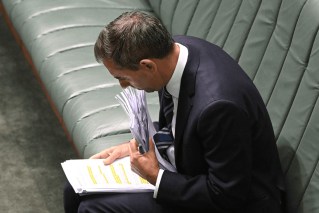
The Liberal Party is stuck in the arguments it set up in the 1990s. Photo: AAP
Winners have parties. Losers have meetings. And there have been a lot of meetings in Canberra this week.
If the definition of insanity is doing the same thing over and over again and expecting different results, than we are in for another rough three years.
There are always set pieces to election wash-ups. Finger pointing. Re-writing of history. People who were silent suddenly expressing ‘long held’ concerns.
Everyone knew all along what was happening, but can only express it once the votes are counted.
What doesn’t happen, is change.
Walking off a cliff
The Liberal Party seems willing to walk all the way off the cliff into electoral irrelevancy, so convinced of their own reflection they have offered up continuity with change as the best possible answer for moving forward.
Sussan Ley, who backed in every single decision her party ever made, defender of its worst instincts, gatherer of the crumbs is on one flank.
Angus Taylor, leader of the ‘should-ofs’, defender of the ‘didn’ts’, king of the crumbs in the other.
Both ‘humbly’ accepting their destiny as saviour, while rejecting any responsibility for creating what it is the party needs saving from.
Taylor has added Jacinta Price to his ticket, so assured he is in his own view of reality, he’s not happy with taking the party to the edge of the cliff, he wants to march it all the way to the earth’s core.
For all the wash-up talk of what muted mavericks apparently always knew to be wrong decisions, there has been no examination of what it is the Liberal Party is supposed to stand for.
The Liberals have always had a way of viewing themselves differently to what they present to the public.
‘Believe in anything’
In a letter to his daughter, written in 1974, Robert Menzies complained of the “what they now call ‘Liberals with a small l’ – that is to say, Liberals who will believe in anything if they think it worth a few votes”.
During the election campaign, Taylor was already laying the groundwork for what he thought would be a leadership challenge against Peter Dutton, selling himself as a ‘dry Liberal’ who wanted to bring back Howard economic rationalisation.
It wasn’t that long ago that Taylor was telling colleagues about his “discomfort” with the “populist” culture wars waged by Dutton and his drive to bring the party back to fundamentals.

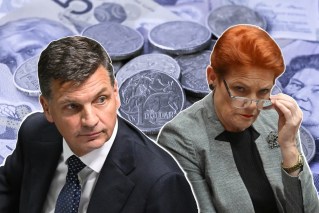
Jacinta Price is expected to run alongside Taylor. Photo: AAP
Obviously a month is a long time in politics, with Taylor now embracing one of the architects of those wars in Jacinta Price in order to defeat Ley, a longtime rival in the party room and offset his own lack of charisma.
If it doesn’t make sense, it’s not meant to. The leader of the party on Tuesday is unlikely to be the leader that leads the party to the next election and the divisions within the party will not be sorted with one vote.
The Liberal Party, founded according to Menzies, to ensure “the farmer, and the farmers’ wife and children, as well as the city dweller, enjoy stability and the amenities of life” has been narrowed to reflect the party room’s own power balance, where the Nationals have taken over the party from the inside, cemented by Price’s official defection.
Shrinking began with Howard
Howard’s so-called ‘broad church’ began shrinking under his own eyes, with the party losing 19 seats in capital cities between 2001 and 2022 (more now, once the final count is done) with the focus shifting to the new ‘forgotten people’ or ‘quiet Australians’ in the outer suburbs.

The Liberal base began to shrink in the Howard years. Photo: AAP
But that too made no sense. Analysis of the vote breakdown in the outer-metropolitan seats the Liberal Party convinced itself was an anchor to power, shows the swings against the Coalition in those electorates between 2013 and 2022 was 5.5 per cent. That was only marginally better than the 5.6 per cent swing against the Coalition nationwide.
At the last election, of the 28 outer-metropolitan seats not held by the Coalition, only five of them were marginal. They won zero and look to have lost another seven, including Menzies.
But it is not the job of the Australian public to sit still while the Liberal Party and the broader Coalition work out what role they want to play in modern Australia.
The party shows no inclination of moving towards the future – it is still arguing over an energy policy most never truly believed in, but is insisting remains viable while completely ignoring that the argument itself is lost.
Labor not only won the election, it won the energy transition. By the time the Coalition, if it even still exists, becomes anything close to being an electoral chance again, at least six years will have passed. It will be into the 2030s.
Stuck in the 1990s
And yet, the Liberal Party is stuck in the arguments it set up in the 1990s. It does not matter what the Liberal Party thinks on energy policy any more than it matters what Clive Palmer thinks about superannuation.
Which raises another question. In this modern era, who is the opposition? Does it remain the Coalition which represents fewer and fewer voters, or does a new bloc from within the parliament form, to challenge the government and contest ideas, to create policy better representative of the Australian public?
Voters have begun making that shift, but it remains to be seen if the media and indeed, the Labor Party do.
The Liberal Party set its own course under Howard. That’s its own choice, one reinforced by every leadership decision made since Tony Abbott. But that doesn’t mean the rest of the nation has to trek alongside it, allowing it to dictate Australia’s future direction.
Ugly shift highlights Australia's biggest challenge
As anti‑govt violence grows, a response must too