Headmaster saved 900 lives in Nepal floods

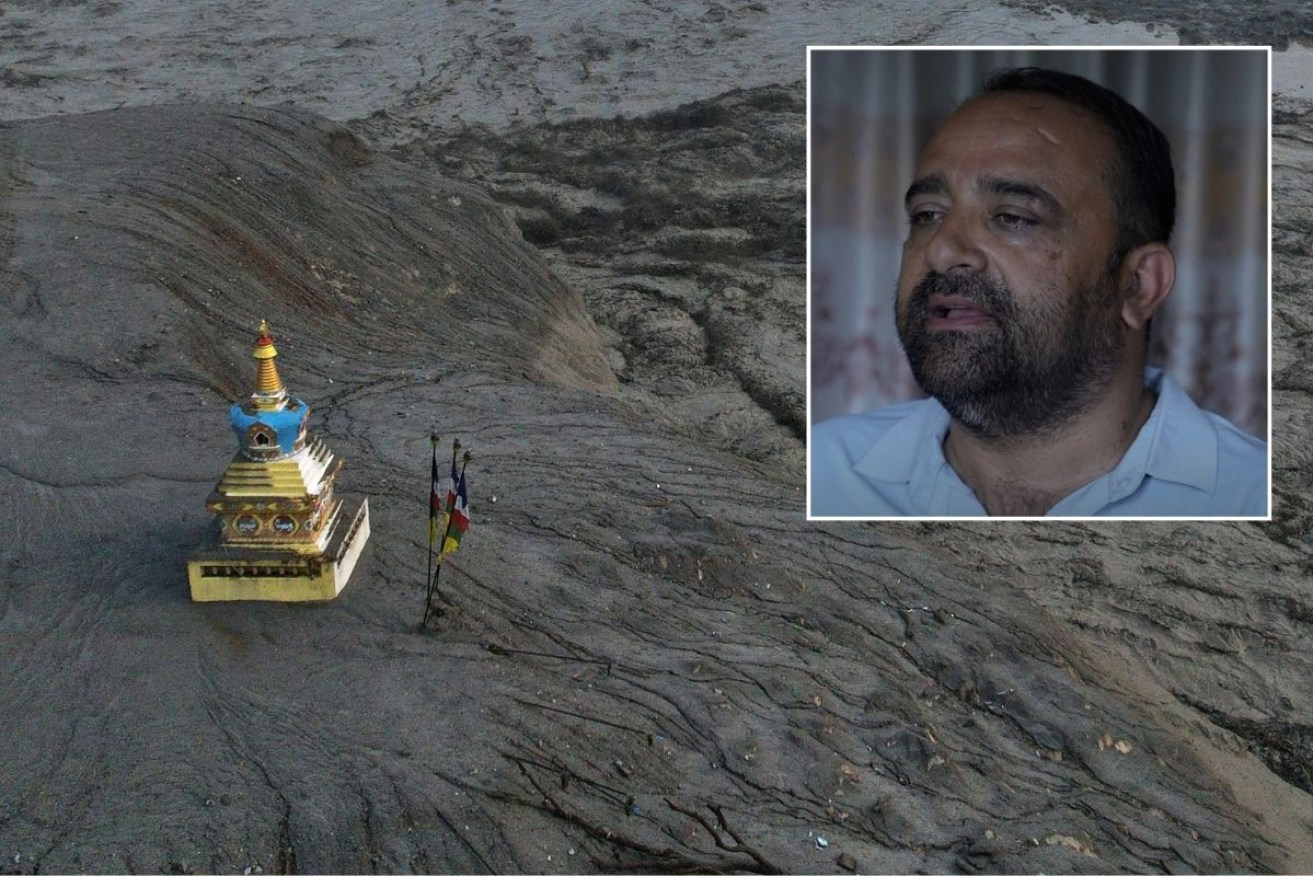
What remains of the bazaar near Tribhuvan Trishuli Secondary School. Inset: Headteacher Rajendra Dawadi. Photo: AAP/BBC
A school headmaster has revealed how he ordered the evacuation of 900 children in Nepal, with students scrambling to safety with literally seconds to spare.
Rajendra Dawadi told children at Tribhuvan Trishuli Secondary School in Nuwakot to run to higher ground — 10 minutes before a wall of water slammed the town.
He told the BBC he had received warnings from four people within the space of minutes, which spurred him to act.
“A parent came and told me that a big flood was coming, ‘I am here to take my daughter, I will take her’,” he told the BBC.
“Parents don’t rush without a strong reason, so it was confirmed that I shouldn’t waste a second to evacuate the children.
“I decided I shouldn’t delay any more. Even if the flood was not coming, it was just a matter of a single day’s classes.
Dawadi added: “If we didn’t make a quick decision, if it was 10 minutes later, we all — including the students and me — wouldn’t be able to speak to you today.”
“I feel proud that we saved so many lives.”
Student Yunisha Amatya, 16, told the BBC she and her friends survived by “just ten seconds” while scrambling to safety.
“Just before the flood came, we were in the class studying. Teachers had gathered in one place and initially had no idea what had happened.
“After five minutes teachers came and informed us about the flood and asked us to go home.”
She said many students initially underestimated the danger and waited for classmates who were in a maths lesson.
Yunisha and her friends scrambled uphill through an escape route behind the school.
“I could not walk fast, and my friends helped me to climb uphill. We escaped through a narrow ladder from backside of the school,” she told the BBC.
“Within no time, the bazaar (a local market around the school) was swept away in front of my eyes.”
“If there was no grip in my shoes I would have fallen and students and other people were jostling each other to reach the safer area while escaping.
“The people who choose to escape from another route are apparently swept away.”
Authorities said the death toll rose to nearly 800 on Sunday, with more than 3000 people missing on both sides of the Nepal-China border after a torrent of ice, rock, mud and debris swept through mountain valleys and rivers on Wednesday, causing widespread devastation.
The Red Cross has estimated that more than 90,000 people are likely to have been affected by the disaster, which China has linked to the effects of climate change.
Chinese Foreign Minister Wang Yi told his Nepalese counterpart during a Saturday telephone call that the mudslide was their “most severe cross-border disaster” in recent years and that rescue operations had risen to an unprecedented level of difficulty and complexity, state broadcaster CCTV reported.
Nepal’s disaster authority said 781 people had died, with 2502 missing.
On the Chinese side, authorities said 16 people were killed in Gyirong County and 546 were missing.
Beijing said 261 foreign nationals from 23 countries were unaccounted for in Tibet, near a key border crossing with Nepal.
The scale of the disaster has complicated rescue efforts across the rugged Himalayan terrain.
Local police in Nepal told Reuters that residents and rescue workers had moved to higher ground after the Trishuli River’s water levels rose in recent hours following fresh rainfall, raising fears of additional flooding.
Rescue operations have been suspended several times since Friday because of bad weather and concerns that a lake formed across the Nepal-China border by the disaster could trigger fresh flooding after it began overflowing into Nepal’s Lhende Khola and Trishuli Rivers.
CCTV reported that the lake threatening downstream areas had been largely drained by Saturday evening.
But drones detected a landslide late on Saturday that is 2.8km downstream of the lake, forming a new dam and a fresh pool of water.
In Nepal, rescue efforts have increasingly focused on five hydropower projects inundated by the floods, including the Upper Trishuli complex, where authorities said on Friday they received information that around 350 people could be trapped inside a tunnel.
About 10,000 Nepali troops have been deployed alongside specialist teams from China and India.
Nepal’s military airlifted heavy machinery to the remote site on Sunday and rescuers reached the entrance of one tunnel, beginning to clear debris blocking access.
Authorities said teams carrying oxygen supplies and cameras would enter once access was secured.
“It’s very tough because there’s a lot of debris and we cannot blast things to make our way through,” said Dharam Raj Uprety, chief of Nepal’s national disaster management authority.
Lok Bahadur Chhetri, a spokesperson for Nepal’s foreign ministry, said Nepal required international assistance in specialised areas, including tunnel rescue operations, DNA testing, refrigerated storage for bodies and forensic identification of decomposed remains.
Days after desperate relatives moved between hospitals, morgues and relief centres searching for loved ones, authorities in Nepal began mass burials of hundreds of unidentified victims whose bodies had started to decompose.
In Chitwan district, about 200 km (125 miles) from the disaster zone, authorities dug hundreds of graves in a forest at Devghat for bodies swept downstream from the flood-hit Rasuwa region.
“We were left with no other option,” said Ganesh Aryal, chief district officer of Chitwan.
“Our concern was the risk to public health posed by the rapid decomposition of the bodies.”
-with AAP
Want to see more stories from The New Daily in your Google search results?
- Click here to set The New Daily as a preferred source.
- Tick the box next to "The New Daily". That's it.

'Blessed': Australian found safe in Nepal