Hope that mystery underwater object could be lost aviator’s plane
Source: The Archaeology Channel
Researchers examining satellite imagery in the remote southern Pacific Ocean happened upon it in 2020.
US Navy veteran Mike Ashmore was scrolling Apple Maps satellite images of the remote Phoenix Islands on his phone when he spotted the unexpected object in a Nikumaroro lagoon.
Working backwards, researchers they soon realised the same mysterious underwater anomaly could also be seen in aerial photographs dating back to 1938.
The baffling provenance of the so-called Taraia Object has finally come full circle, with the launch of a major investigation after almost 90 years.
The question on everyone’s lips is whether the unidentified object could be the long-lost wreckage of Amelia Earhart’s Lockheed Electra.

The mystery Taraia Object in waters off a Kiribati island. Photo: AAP
The famed American aviator and her navigator Fred Noonan disappeared in the twin-engine plane during her mission to become the first woman to circumnavigate the globe on July 2, 1937.
Four days earlier, Earhart had touched down in Darwin, her only mainland Australian stop, before heading to Papua New Guinea the next morning.
After checking and adjusting equipment in Lae, she set off on her ill-fated third-to-last leg of the mission to Howland Island, never to be seen again.
Authorities had long concluded the aircraft plunged into the sea and sank in very deep water.
The Taraia Object lies in a shallow coral lagoon known as Nikumaroro. It is midway between Australia and Hawaii in the geographically obscure Phoenix Islands and just 640 kilometres south-east of Howland.
Bones found on one of the Phoenix islands in 1940 were determined in 2018 to be “99 per cent” likely to be those of Earhart. They have since been lost.
US expeditioners have gathered in Kiribati, of which the Phoenix Islands are party. From their base, they will visit the location of the mystery object and hopefully put speculation to rest once and for all.
The group comprises experts from Purdue University in Indiana, the Purdue Research Foundation and the US Archaeological Legacy Institute.
Their work will initially focus on remote sensing with magnetometers and sonar to inspect the object.
They will then use a hydraulic dredge to expose the item so they can see what it is. They will also search the surrounding area for any washed-up debris.
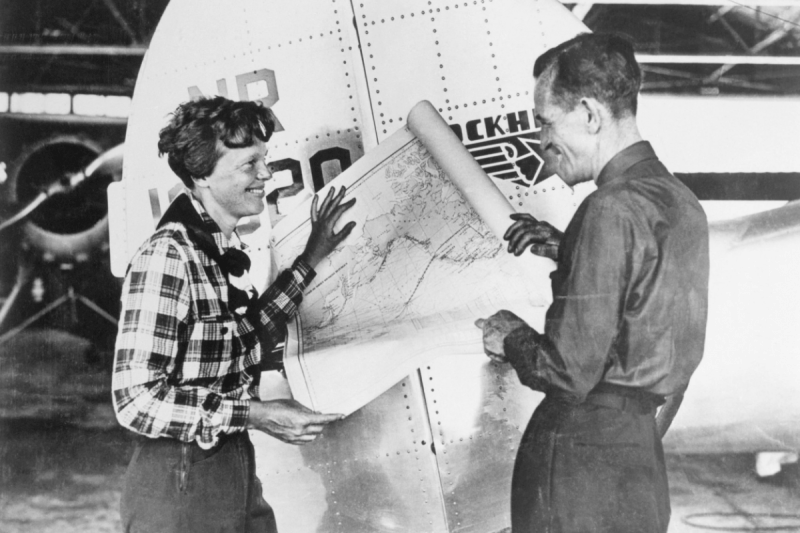
Earhart and navigator Fred Noonan, holding a map that shows the route of the last flight – which they never made. Photo: Getty
For project director Rick Pettigrew, the mission offers the opportunity to solve one of the great mysteries of the 20th century.
“Finding Amelia Earhart’s Electra aircraft would be the discovery of a lifetime,” he says.
“With such a great amount of very strong evidence, we feel we have no choice but to move forward and hopefully return with proof.”
The Purdue Research Foundation originally funded Earhart’s Lockheed Electra Flying Laboratory through her aeronautical research fund.
She planned ultimately to fly the aircraft back to Indiana after her trip.
“Amelia’s legacy remains strong at Purdue and she looms large in our canon of heroes,” expeditioner Steve Schultz says.
“Successfully identifying the Electra would be the first step toward fulfilling her intention to return it to the university.
“We owe it to her legacy to try to find a way to bring it home if we find it.”
Earhart was already an aviation great when she began her attempt to circumnavigate the globe along the equator, having become the first woman to fly solo and non-stop across the Atlantic in 1932.
She went to Purdue in 1935 and worked as a women’s career counsellor and advisor in the university’s aeronautics department.
Purdue graduate, astronaut and expedition member Sirisha Bandla says Earhart inspired countless women to pursue their dreams and was a “true aviation pioneer who refused to let limits define her future”.
The Phoenix Islands Protected Area is the largest and deepest UNESCO World Heritage Site on Earth.
The spectacular region is so remote it is six days sailing from Honolulu.
Nikumaroro is one of eight low-lying atolls that make up the Phoenix archipelago. Kanton Island is the only inhabited island in the group, with just 50 residents.
The Taraia Object is named for the Taraia Peninsula, a land feature that products south-west from the northern side of Nikumaroro lagoon.
Dr Pettigrew says he believes there is evidence to suggest Earhart and Noonan landed on Nikumaroro and camped there for some time.
After scanning almost 9000 square kilometres of sea floor near Howland Island, another expedition team recorded a sonar image that appeared to resemble Earhart’s aircraft in 2024.
However, the object was found to be a rock formation.
The Archaeology Channel will document the current expedition with short vlogs on its streaming platform.
-AAP