Jill Stark: Coronavirus crisis put playing back in our hands

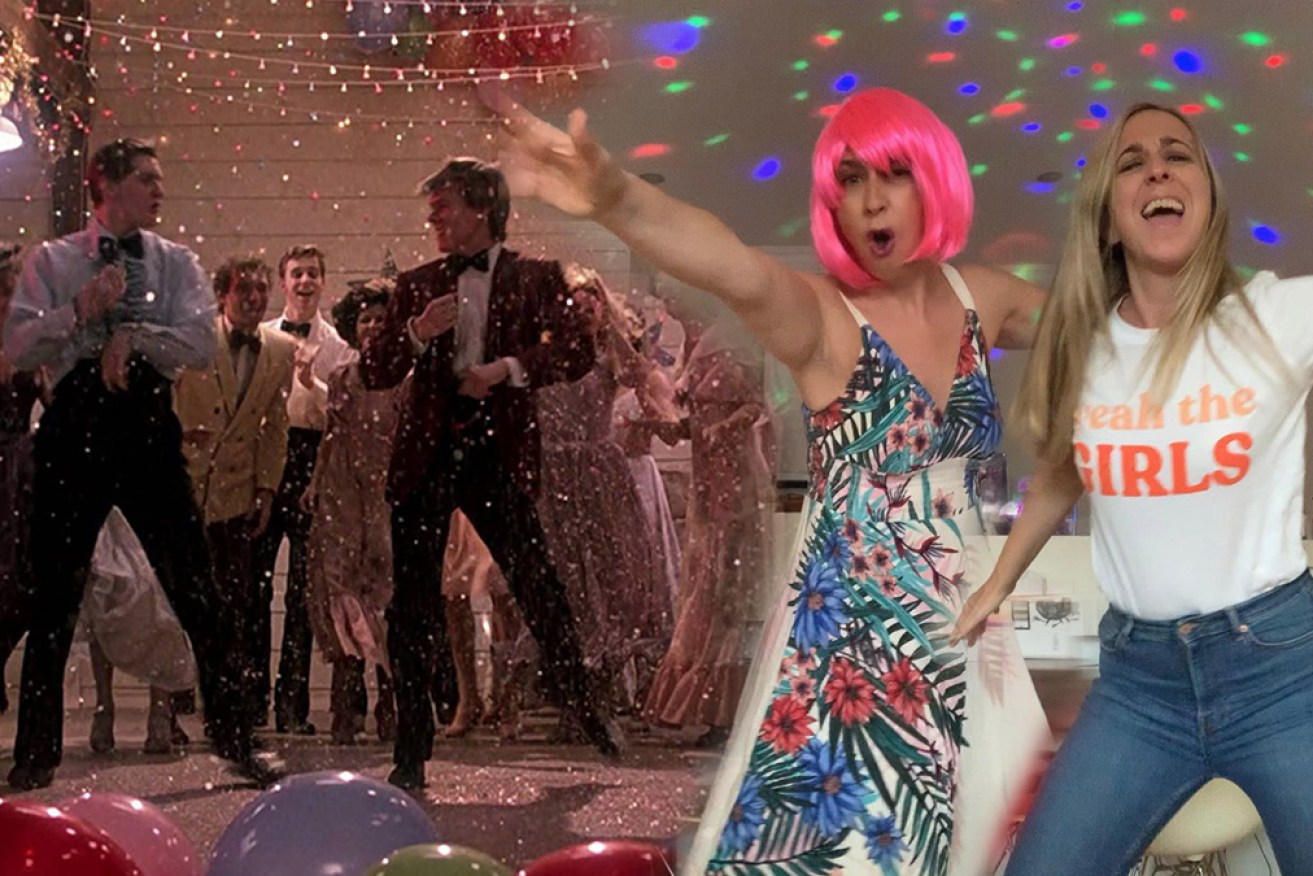
Even in the coronavirus crisis, you gotta cut loose. Picture: TND
Our world has been a dark place these past few months.
The news is a non-stop cycle of doomsday scenes and terrifying economic projections.
There hasn’t been much room for joy.
But at a time when the weight of the world bears down so heavily, it’s more important than ever to create moments of lightness.
For me, that has meant making a daily commitment to fun.
Every night for the past two months, I’ve turned on a mirror ball disco light in my lounge room, cranked up one of my favourite songs and thrown a self-isolation dance party for one.
These pockets of joy at a time of heightened anxiety have been an incredible tension release.
For a few minutes each night, I feel free.
Taking time out to play is something we don’t do nearly enough as adults.
As children, we run at full tilt, dance like no one’s watching and generally live a life that is untethered and guilt-free.
Then we grow up and become crushed by the burden of adult responsibility, societal expectation and self-consciousness.
We forget what it feels like to let go.
Playtime becomes an indulgence.
But taking time out for joy and silliness is not selfish – it’s an act of self-replenishment.
In my book, Happy Never After, I spoke with one of the world’s leading play researchers who told me that there is a growing body of evidence to show that playtime in adulthood is critical to human development.
Dr Stuart Brown, a psychiatrist from the National Institute for Play in California, told me that making time to play can have a profound effect on our mental wellbeing.
Put simply, we need to play to thrive.

“Yeah, I wanna dance with somebody…”
“Although we can survive into adulthood without it, we don’t survive socially, emotionally, cognitively with any kind of fullness without having a healthy play background that continues throughout life. It is a sustaining, important part of being human,” Dr Brown said.
In these times of great uncertainty and upheaval, finding time to tap into that play nature may seem frivolous but it also could be protective.
As play researcher Brian Sutton-Smith says in his book The Ambiguity of Play, the opposite of play is not work, it’s depression.
That doesn’t mean that if we choose to have dance parties in our lounge or find time to laugh with friends, we ignore the seriousness of the situation we face as a community.
Nor that we forget those who are doing it tougher than us.
But if we want to be equipped to cope with all that lies ahead, and to support others and ourselves, we need to occasionally switch off and make room for fun.
So how can you introduce more playtime into your day?
Dr Brown defines play as any activity that is deeply engaging, joyful and done for its own sake, without consideration of time or an expected outcome.
It is fun in its purest form.

For Jill Stark, this is fun in its purest form.
That could mean different things to different people.
It might be rolling around on the floor with a pet, having a food fight with your kids, rocking out the air guitar in your bedroom, spending time in the garden, or baking a tray of cupcakes.
The most important thing is to allow yourself to let go and fully lean into the moment, without guilt or judgment.
These are incredibly challenging times and it’s OK to take time out for yourself.
It’s OK to still find joy in the little things.
If we’re going to find our way through the dark, we need to carve out space for the light.
Jill Stark is the author of When You’re Not OK, Happy Never After and High Sobriety