If not for one shining moment of goodwill displayed in federal parliament on Thursday afternoon, this week in politics would have been consigned to waste bin of political history.
Parliamentary Question Time consisted of little more than the government providing shrill, abusive and repetitive answers to the Opposition’s shrill, abusive and repetitive questions.
The cacophony of MPs yelling at each other across the chamber while ministers tried to ‘answer’ questions was so loud the Speaker complained he could barely hear what was being said.
It is in fact a microcosm of the bad behaviour that now passes for normal conduct in one of the nation’s highest decision-making bodies.
Labor bellowed for the head of Turnbull minister Michaelia Cash when the Federal Court issued a third subpoena at the AWU’s request this week, summoning the minister to be questioned about her knowledge of the media being tipped off before the union’s offices were raided by the federal police.
In response, government ministers yelled at Labor leader Bill Shorten about the reason for the raid, which was to uncover whether Mr Shorten had the union’s permission to donate $100,000 from its coffers to GetUp! when he was in charge of the AWU and a director of the activist group.
Then there was Health minister, Greg Hunt, who abused an elderly local government politician during a meeting late last year, but didn’t get around to apologising until his bad behaviour hit the tabloid media in his home state.
Only once Labor started insinuating in Parliament that this wasn’t Mr Hunt’s only misdemeanour did the minister offer profuse but hollow apologies for the first incident and fess up to one other.
The most spectacular – and therefore unedifying – dummy spit of the week ironically occurred because of another politician’s noble gesture.
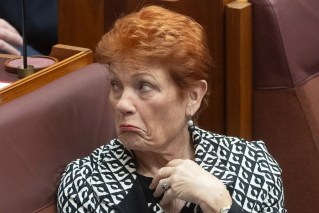
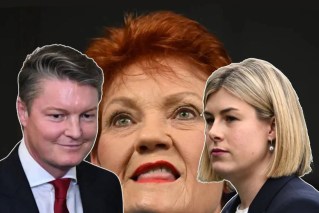
After breaking a ‘handshake deal’ with Finance Minister Mathias Cormann to support the government’s corporate tax cuts, Pauline Hanson publicly issued veiled threats to one of her senators, Brian Burston, when he announced he would instead stick to the deal.
Then Senator Hanson shed angry tears while claiming victim status after the threats didn’t work. On Friday afternoon she took the nuclear option, publishing a letter in which she advised Senator Burston that he’d been removed from two administrative roles in One Nation and asked him to prove his proclaimed loyalty to her by resigning from the Senate.
Senator Burston may instead choose to resign from PHON and stay in the Senate.
Meanwhile, both Liberals and Nationals poured scorn on Barnaby Joyce for selling his sordid story to a commercial TV network after spending the past few months huffing about his right to privacy.
Over in the Labor camp, the right faction teamed up with left-wing unions last weekend to stop the rest of the left from bringing on the discussion of contentious issues, like offshore detention, at the Victorian Labor Party’s state conference .
Yes, this is all part of the rough and tumble that comes with being politically active in a vibrant democracy. But there may be a growing concern within the broader community that Australian politics has descended into a shouty quagmire that is too adversarial and not conducive to politicians working together on ‘big issues’.
It’s no coincidence Opposition Leader Bill Shorten admitted in his address to the National Press Club earlier this year that “2017 was a particularly bad year for Parliament” because “there was too much circus, [and] too much bickering and squabbling”.
Mr Shorten said at the time “I’m prepared to take my share of responsibility”, and that he would “do better in future” to avoid “reducing every political debate to a petty squabble.”
The Labor leader has used usual similar lines a couple of times since. It would be interesting to know whether an uncommitted voter who endured any of this week’s Question Time sessions would conclude that Mr Shorten has upheld that commitment.
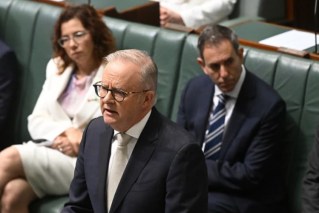
This may be why the Labor leader’s unofficial adversary, the ‘people’s choice’ Anthony Albanese, warned this week against the increasingly adversarial nature of the Parliament.
Mr Albanese argued that politicians should “commit ourselves to make a difference, not just for ourselves and our political parties in a partisan way, but in the national interest”. In his view, “this Parliament doesn’t do that enough”.
The Labor frontbencher said that politicians should be taking steps to create a better future, which often meant bipartisanship on long-term issues such as climate change, Indigenous disadvantage and intergenerational inequality.
Before such an utterance is dismissed as the wishful thinking of a Labor lefty, it should be noted that Mr Albanese’s plea for bipartisanship on the big issues was vindicated before the Parliament rose at the end of the week.
It was announced this week that the Catholic and Anglican churches as well as the Salvos, Scouts and YMCA, would sign up to the National Redress Scheme for the survivors of institutional child abuse.
When recognising this in the Parliament on Thursday, the responsible minister Dan Tehan not only thanked his Labor counterpart for her support of the scheme, he also recognised former PM Julia Gillard for creating the royal commission that started the process of restitution.
That singular moment of generosity and empathy was the Parliament’s only redeeming feature this week. Nothing else that occurred over the past seven days in federal politics suggests that Mr Albanese’s call will be heeded by his colleagues or his opponents.