Killer cop’s behavioural past and psychology questioned
Source: NSW Supreme Court/AAP
As he faces a future destined never to extend beyond prison walls, Beau Lamarre-Condon’s past is under increasing scrutiny.
The former police officer learned his fate on Wednesday when a NSW Supreme Court jury took just two hours to find he murdered ex-lover Jesse Baird and Baird’s new partner Luke Davies in February 2024.
Lamarre-Condon entered Baird’s Sydney terrace disguised as an UberEats driver and armed with his service pistol. He executed Baird in cold blood before fatally shooting Davies to silence a potential witness.
While the 31-year-old faces the possibility of dying behind bars, many wonder how such a clearly fixated and obsessive man was able to avoid notice before taking two lives.
During his trial, several of Lamarre-Condon’s closest friends recalled the one-time senior constable revealing to them details of his coercive behaviour towards Baird, which escalated after the TV presenter began dating Davies.
“Beau told me he accessed Jesse’s phone … he knew his PIN code,” Lamarre-Condon’s former NSW Police colleague and friend Alexandra Scobie told the court.
“He accessed Jesse’s Instagram and removed some people that were following Jesse … some other men that seemed interested.”

Lamarre-Condon executed Jesse Baird (right) and his new partner Luke Davies at Baird’s Sydney home. Photo: Sky News
Forensic psychologist Nathan Brooks said the feelings of betrayal that Lamarre-Condon associated with his eventual victim were symptomatic of a wider trend among violent criminals.
“Being aggrieved loads the gun, becoming fixated and psychologically preoccupied aims it and developing overvalued beliefs and overweighted ideas pulls a trigger,” Brooks said.
“The new relationship [with Davies] clearly caused that psychological injury and, as a result, the fixation and sense of being aggrieved developed from there.”
Many of Lamarre-Condon’s friends – including Scobie – tried to convince him to advance beyond Baird in a healthy way.
“He was really angry; he wasn’t happy at all,” Scobie said.
“We were really reiterating the need to move on and let it go.”
Lamarre-Condon asked specific questions of many police colleagues about investigative protocols in the months before the murders.
“That does speak to his vulnerable personality structure … there’s an inadequacy there where he is trying to gain information from other people because he is struggling to do that himself,” Brooks says.
But Lamarre-Condon also subjected non-police friends to disturbing violent hypotheticals.
“If you did kill someone, what would you do with their bodies?” he asked Georgia Cook at what was meant to be a friendly dinner.
“After I kill them, I would take their stuff, put it in the dumpster and I would take their bodies to bushland where no one would ever find them,” he answered to his own question months before carrying out almost an identical plan.
Recalling the startling conversation had a visible emotional effect on Cook as she gave evidence.
“I was just really scared by what I had heard … I couldn’t continue the friendship after hearing these things,” she said.
Lamarre-Condon disposed of Baird and Davies’ bodies in surfboard bags at a rural Greek monastery in Bungonia, about 200 kilometres south of Sydney.
He initially tried to sink them in a farm dam using quick-set concrete and gym weights.
Despite the disturbing nature of many of Lamarre-Condon’s interactions with friends and colleagues, Brooks said there was no easy way of spotting who might turn psychological vulnerabilities to cold-blooded murder.
“A lot of murderers are unremarkable … there are often many psychological factors that probably needed intervention but they’re not obvious to people around them,” he said.
“The more the person becomes consumed and doesn’t have the skills to resolve those efforts in a pro-social way, the easier it is for them to become stuck and fixated.”
There may not be a template for how to spot a murderer based on snippets of conversation but Lamarre-Condon’s decision to give evidence in his double murder trial spoke much about his character.
Criminologist and former police officer Michael Kennedy said Lamarre-Condon showed clear traits of narcissism both in the witness box and in the recollections of his peers.
“He’s a performer and getting in the witness box, the attention-seeking side of things is on him,” Kennedy said.
“There’s no great surprise that he’s not going to make it easy for people.”
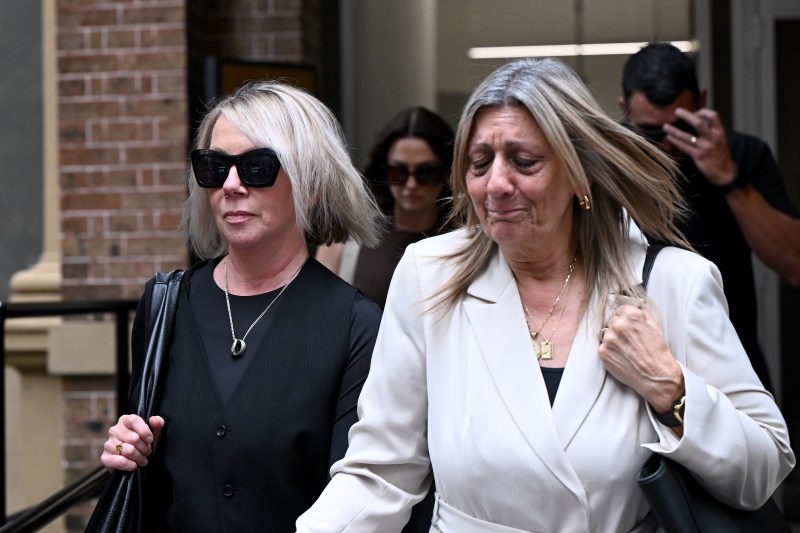
Helen Baird (left), the mother of Jesse, and Luke Davies’ mother Sandra leave court after the guilty verdicts. Photo: AAP
Lamarre-Condon’s obsession with fame and the famous was another common theme.
Friend Stacey Parker told the court she saw a selfie of him close to celebrity couple Kourtney Kardashian and Travis Barker only three days before the double homicide.
Kennedy said fulfilling a personal mission while plotting a diabolical act ws further evidence of warped priorities.
“Why could he do other things in the middle of killing people?” he said.
“He went out on the celebrity circuit, trying to get pictures with celebrities in the middle of it all because he was totally focused on himself.”
Lamarre-Condon’s career as a police officer has been scrutinised since the verdict, with a video appearing to show him repeatedly using a Taser against an arrest target in 2020.
Kennedy knew complaints were made about Lamarre-Condon during police academy training at Goulburn.
But he said any suggestion the 31-year-old leveraged his mother’s career in the force to skirt recruiting guidelines was ridiculous.
“There’s only one way to join the police – you go through the recruiting system and there’s no way around it,” he said.
Lamarre-Condon will return to the NSW Supreme Court for a sentencing hearing on March 11.
1800 RESPECT 1800 737 732
Lifeline 131 114
Men’s Referral Service 1300 766 491
-AAP