Trump says US will attack Iran ‘very hard’

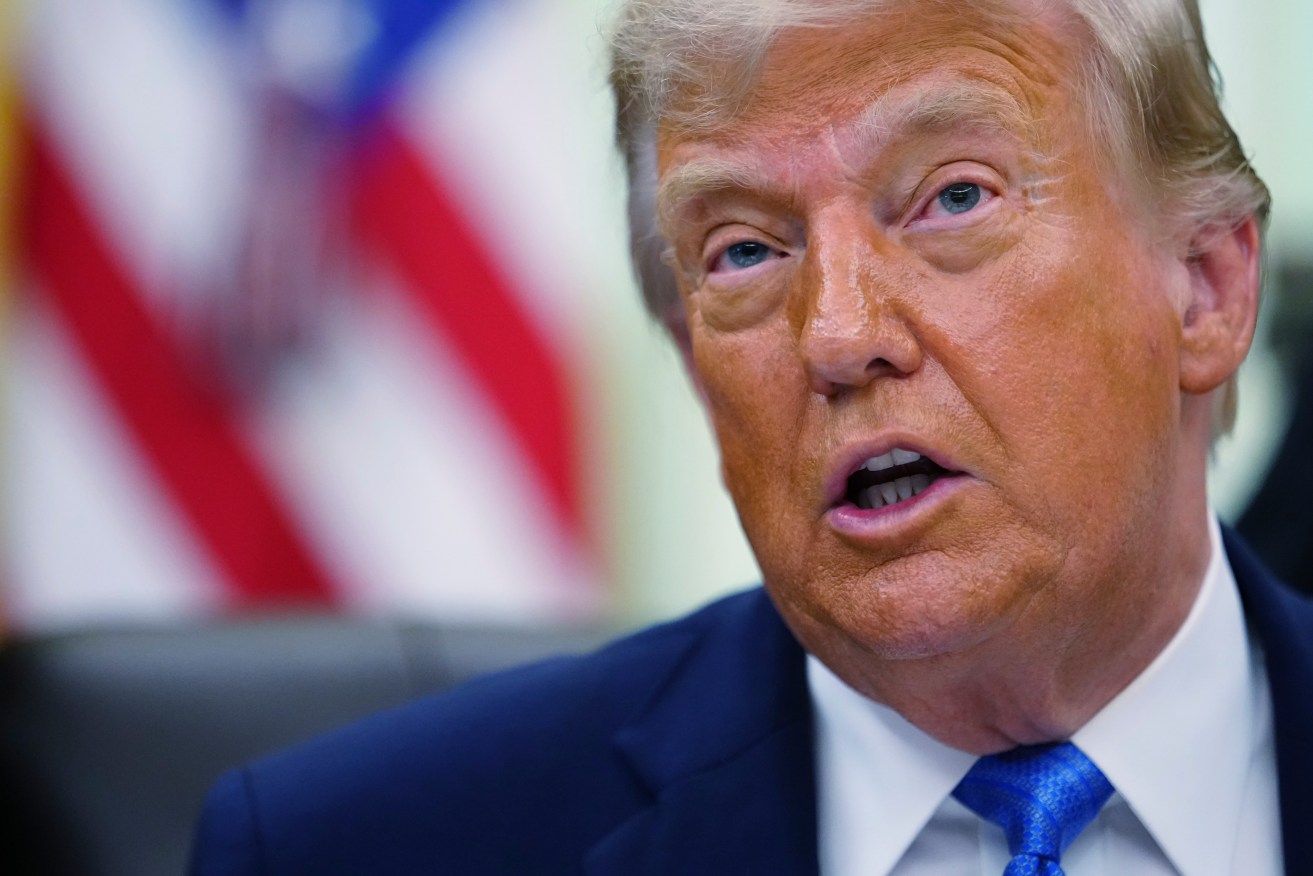
"Iran is all talk and no action," President Donald Trump says about negotiations with the US. Photo: AAP
US President Donald Trump says the United States is going to attack Iran “very hard” if no peace deal is finalised and has announced the US has been taking oil out of Iran.
“We’re going to be attacking them, attacking them very hard,” Trump told reporters at the White House, citing Iran’s downing of an Apache helicopter in the Strait of Hormuz.
The president reiterated that Iran will be hit on Wednesday.
Trump also revealed that the United States has been taking oil out of Iran.
“I’m just announcing today for the first time, but we’ve been taking out millions of barrels of oil, millions of barrels every night,” Trump said, adding that Iran “just figured it out”.
“Millions of barrels of oil has come out, and that’s why it’s at $US85-90 a barrel, instead of $US250,” Trump said, sharing no other details about these operations.
He later said more than 100 million barrels of crude had passed through the Straits of Hormuz as part of what he called a secret US mission to support oil tankers.
“More than 200 Commercial Ships have safely travelled through the Strait,” he said in a post on Truth Social.
Trump said the United States is still looking to make a deal.
“We want a deal that is meaningful, we want a deal that works,” Trump added about the negotiations with Iran.
Trump said that Iran has already agreed to not obtaining a nuclear weapon but the agreement still needs to be signed.
Meanwhile, the United Nations nuclear watchdog’s 35-country Board of Governors passed a US-backed resolution telling Iran to declare its remaining enriched uranium stocks and let inspectors verify them.
The move came within hours of the US and Iran trading military strikes.
Israeli and US attacks in June of last year destroyed or badly damaged Iranian uranium-enrichment plants but much of the enriched uranium they produced, including material close to weapons-grade, is thought to have survived.
Iran still has not informed the International Atomic Energy Agency of the fate of that material, or let IAEA inspectors return to the bombed sites to check.
The US led the push for the resolution but Iran has called it “whitewashing military aggression” since inspectors had access before the strikes.
The resolution text submitted by the US, United Kingdom, France and Germany was passed with 21 votes in favour, three against and 10 abstentions, diplomats at the closed-door meeting said.
The countries opposing were Russia, China and Niger, they said.
Iran’s mission to the IAEA had warned the board to be “cautious on the path forward”.
Iran bristles at resolutions against it, and has responded to previous ones by escalating its atomic activities or scaling back co-operation with the IAEA.
The resolution said Iran should “provide the agency with complete information on nuclear material inventories” and grant the IAEA the access it needs to verify that “without delay”.
The US and Iran are in talks aimed at extending their ceasefire and paving the way for wider negotiations on issues including Iran’s nuclear program.
Trump appeared to express frustration at the negotiations, having repeatedly said for months that the two sides are close to an initial agreement.
“Iran is all talk and no action,” Trump said in a social media post on Wednesday.
“They’ve taken too long to negotiate a deal that would have been great for them, now they will have to pay the price!!!”
A key aim of Trump’s is removing Iran’s enriched uranium, particularly the 440.9 kg enriched to up to 60 per cent purity, a short step from the roughly 90 per cent of weapons grade, the IAEA estimates Iran had until the first Israeli strikes on June 13 of last year.
That is enough, if enriched further, for 10 nuclear weapons, according to an IAEA yardstick.
How much of it remains is unclear.
Iran has taken too long to negotiate a deal and will now “have to pay the price”, President Donald Trump says, while Tehran is reassessing diplomatic engagement with Washington after tit-for-tat strikes.
Iran launched missile and drone attacks on US bases in Jordan, Kuwait and Bahrain in retaliation for American strikes on Iranian targets around the Strait of Hormuz.
The exchange of fire, which came after Trump said Iran had downed a US Apache helicopter near the strait, marks one of the most significant escalations since Washington and Tehran agreed to a ceasefire in April.
“Iran is all talk and no action,” Trump said in a social media post on Wednesday.
“They’ve taken too long to negotiate a deal that would have been great for them, now they will have to pay the price!!!”
The US military said it had targeted Iranian air defences, ground control stations and surveillance radar sites in what it described as a “proportional response” to the downing of the helicopter, whose two crew members were rescued.
Iran’s Gulf neighbours and Jordan activated air defences to intercept incoming missiles and there were no immediate reports of damage to US bases.
The escalation – just days after Iran exchanged strikes with Israel for the first time since the ceasefire – cast fresh doubt on prospects for a deal to end the war, which began on February 28 with joint US-Israeli strikes on Iran.
Iran’s foreign ministry said Tehran would “reassess” its diplomatic engagement with Washington after what it called repeated ceasefire violations.
“Any diplomatic process requires a minimum stable environment,” spokesman Esmaeil Baghaei said.
The US strikes lasted about four hours early on Wednesday, and a US official said almost 20 Iranian targets were hit.
Iran’s Islamic Revolutionary Guard Corps (IRGC) said Qeshm Island and the port of Sirik were attacked.
Iranian media also reported explosions in Bandar Abbas, another port city, and later near Jask at the entrance to the Strait of Hormuz.
-with AAP/dpa
Want to see more stories from The New Daily in your Google search results?
- Click here to set The New Daily as a preferred source.
- Tick the box next to "The New Daily". That's it.

Voters want truth in political ads. Will pollies listen?

More millions as Whyalla Steelworks jobs slashed