Run on Bunnings amid fears of widespread fuel shortages

Source: AAP
Motorists are being urged to resist stockpiling fuel at home and farmers are warning of surging food prices as the Iran war threatens a global fuel shortage.
It comes as hardware chain Bunnings reports a run on fuel containers and supplies in some regional towns begin to run out.
The NRMA said some service stations were running low on fuel because Australians were buying it a greater rate than normal.
“We are also hearing troubling reports of people trying to stockpile fuel at home, which, apart from not making any economic sense, is also extremely dangerous,” spokesperson Peter Khoury said on Monday.
“Please do not put jerry cans in the garage, because that is unsafe.
“We really want Australians to slow down and to go back to their normal buying habits for fuel and please do not panic.”
Shipping has been disrupted with the closing of the strait of Hormuz, one of the world’s most important oil corridors.
Oil companies have been accused of jacking up the price of fuel as the average price of unleaded petrol soared past $2 a litre in Sydney, Melbourne and Brisbane due to the war in the Middle East.
A photo emerged at the weekend showed a near-empty shelf of fuel containers at one Bunnings outlet.
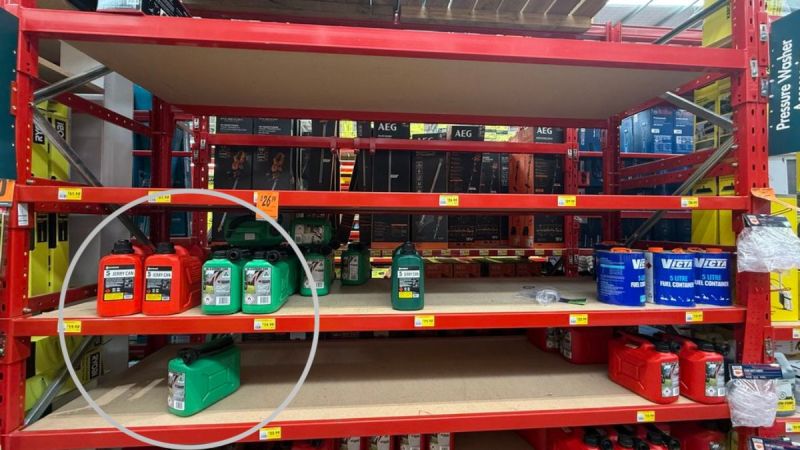
Bunnings says there has been a run on jerry cans across the country. Photo: Seven Network
“We are seeing increased demand for fuel containers in our stores across the country,” a Bunnings spokesperson told the Seven Network.
“Our teams are working hard to ensure product is still available for our customers, with more coming to stores this week.”
There were reports from south-east Queensland at the weekend of people stockpiling fuel, including filling jerrycans. One person told Seven of being confronted by another customer while filling a five-litre jerry can for their lawn mower.
“The woman on the pump beside started going off at me for hoarding fuel and how I was bad as the people during Covid with toilet paper,” they wrote.
“I politely told her it was only five litres and for my lawn mower… to which I got a second verbal bashing basically accusing me of lying and that she was going to report me.”
Also on Monday, Jasmine Russell from the only petrol station in the Mallee town of Karoonda – about 150 kilometres east of Adelaide – said its bowsers had run dry.
“We don’t know when we will have fuel next,”she said.
Russell said the Karoonda Fuel Stop had been drastically affected by panic buyers and she did not receive her “full order” for her 2000-litre petrol and diesel tanks.
“Everyone is buying it as soon as they can get it, so it’s gone as soon as it’s in the tank,” she told Seven.
“If everyone slowed down, we would still have fuel.”
There were also reports of other regional South Australian towns, including Lameroo, Whyalla, Ceduna and Kimba, either running dry or having low supplies.
“We are waiting for a boat to come, but then that would supply the bigger servos first, then the local independents,” Russell said.
“If you leave Adelaide, you want to make sure you have a full tank of fuel.”
The ABC reported that at least two towns in regional Western Australian have begun rationing fuel to emergency services only.
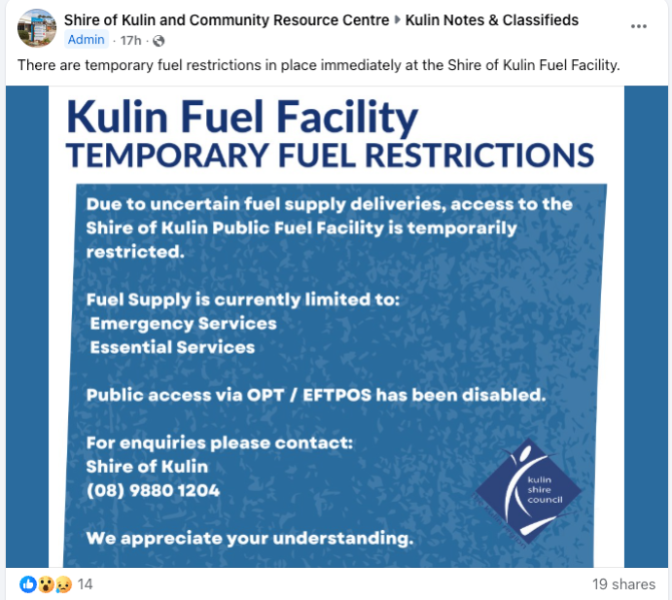
A Facebook post from WA’s Shire of Kulin.
At Corrigin, in WA’s central wheatbelt, roadhouse owner Scott Coppin said he had put a 30-litre limit on unleaded fuel, and a 200-litre limit on diesel until he could secure more supplies.
“It was like a scene out of a movie,” he said.
“It was quite unreal to watch people lining up. We don’t normally see that … maybe on an Easter long weekend or something, but not just on a regular old Monday.”
In Victoria, the state government moved on Tuesday to compel fuel retailers to set daily cap on fuel prices. It must be published by 2pm each day, and will apply for 24 hours from 6am the next day.
Across the country, farmers have warned they are running low on diesel and are concerned the limited supply of oil will have greater economic ramifications.
“The conflict in the Middle East reiterates how Australian farmers are at the mercy of geopolitical tensions because of their heavy reliance on imported inputs and export markets,” National Farmers’ Federation president Hamish McIntyre said.
“Livestock exports have been disrupted and we expect farmers will soon face higher fuel and fertiliser prices.
“Without fuel and fertiliser, farmers simply can’t get food and fibre to consumers.”
McIntyre said costs on perishable goods such as dairy, fruit and vegetables could rise by 40 to 50 per cent if constraints continued.
“It’s a double effect – it’s cost of delivery, plus cost to farmers that will add up to a greater cost for consumers in our supermarkets,” he said.
Treasurer Jim Chalmers has asked the Australian Competition and Consumer Commission to monitor prices as the war continues.
-with AAP